In recent years, aluminium profiles have become one of the most essential materials in construction, interior design, and industrial manufacturing. Their popularity comes from their durability, lightweight structure, flexibility in shaping, and easy surface finishing. To produce a high-quality aluminium profile, manufacturers must follow a strict production process—from raw material selection to surface treatment. Among all materials, Aluminium Alloy 6063 is the most widely used because it is perfectly optimized for aluminium extrusion technology.
This article provides a comprehensive explanation of the 7 key stages, from billet preparation to final finishing with Powder Coating or Anodizing, helping readers understand why quality control is crucial in aluminium profile production.
Stage 1: Billet Preparation – The Foundation of Aluminium 6063 Quality
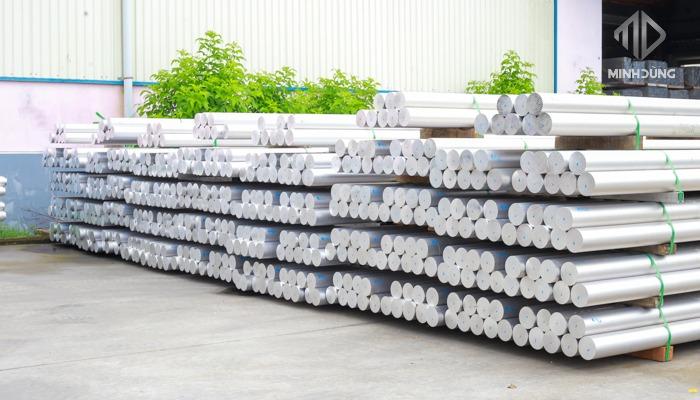
This is the first and most critical step, as it directly determines the mechanical properties of the final aluminium profile. Aluminium 6063 is the preferred alloy thanks to its excellent extrudability, smooth surface finish, and natural corrosion resistance. The alloy mainly contains Magnesium (Mg) and Silicon (Si), forming the Mg₂Si phase, which plays a key role in hardness after ageing.
Before extrusion, billets must undergo a spectrographic test to ensure all alloying elements are within the allowed range. The billets are then cut with a hot saw to achieve precise dimensions suitable for the extrusion press. Even small deviations in this step can affect surface quality or create defects during extrusion.
Typical technical requirements include:
- Correct 6063 chemical composition (Mg ~0.45–0.9%, Si ~0.2–0.6%)
- Composition tolerance: ±0.05%
- Uniform billet dimensions according to press specifications
Stage 2: Die Design and Preparation – Ensuring Precise Profile Geometry
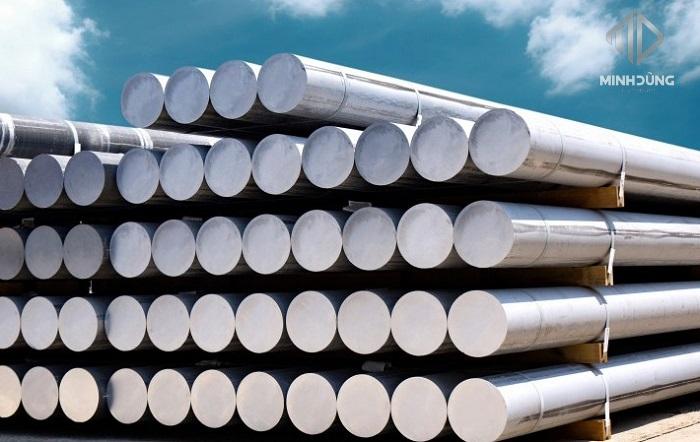
The extrusion die directly shapes the aluminium profile, so its design must be carefully calculated using 3D simulation software to predict metal flow, friction, deformation risks, and the shrinkage rate of Aluminium 6063.
The die is made from heat-resistant H13 steel, capable of with standing wear and continuous high-temperature operation. Before extrusion, the die must be preheater to a stable temperature to avoid thermal shock and ensure smooth metal flow.
Common die standards include:
- Die hardness: HRC 46–48
- Die preheating temperature: 450–530°C
- Profile tolerance after extrusion: below 0.1 mm
Stage 3: Pre-Heating – Optimizing Aluminium Plasticity
This step determines whether the billet becomes soft enough to pass through the die. Billets are heated in a pre-heating furnace to around 450–500°C. At this temperature, the aluminium reaches the ideal plastic state—soft enough for extrusion, but not so hot that it melts or causes surface defects.
Mean while, the die temperature must also be maintained between 450–530°C to ensure a stable metal flow and prevent rough or porous surfaces.
Stage 4: Aluminium Extrusion – The Core Shaping Process
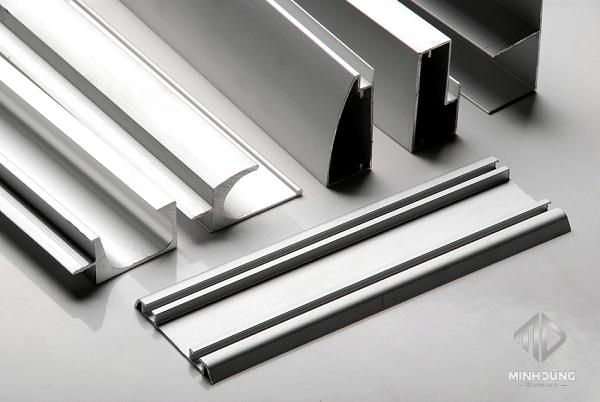
The extrusion stage is the most critical step in the entire aluminum profile manufacturing process. In this phase, the heated 6063 aluminum alloy billet is transformed into profile shapes based on the die design. A hydraulic press generates extremely high pressure, forcing the softened metal to flow through the die opening and form the desired cross-section.
During extrusion, extrusion speed is the key factor. If the speed is too high, the profile may develop hot tearing or surface roughness known as the porcupine effect. Conversely, if the speed is too low, the product surface can become dark, the metal flow becomes unstable, and productivity decreases. For this reason, the factory must carefully adjust the speed according to the complexity of the die, the profile thickness, and the properties of the alloy.
The metal temperature at the die exit is also continuously monitored to ensure smooth metal flow, a clean surface finish, and to prevent deformation caused by overheating. In addition, extrusion pressure and die exit angle are precisely calculated to ensure that the aluminum profile exits the die with high continuity and minimal defects.
This stage concludes once the profile is pushed out onto the run-out table, ready for rapid cooling and straightening in the next production steps.
Stage 5: Cooling, Stretching and Cutting – Stabilizing Geometry and Strength
After exiting the die, the aluminium profile is still extremely hot and must be cooled immediately. Depending on mechanical requirements, cooling may be performed using air quenching or water spray.
Once cooled to the proper temperature, the profile is stretched to remove internal stresses, eliminate bending or twisting, and ensure excellent straightness—a mandatory quality requirement for all aluminium profiles.
Finally, the profiles are cut into standard lengths (usually 6 meters) and prepared for heat treatment.
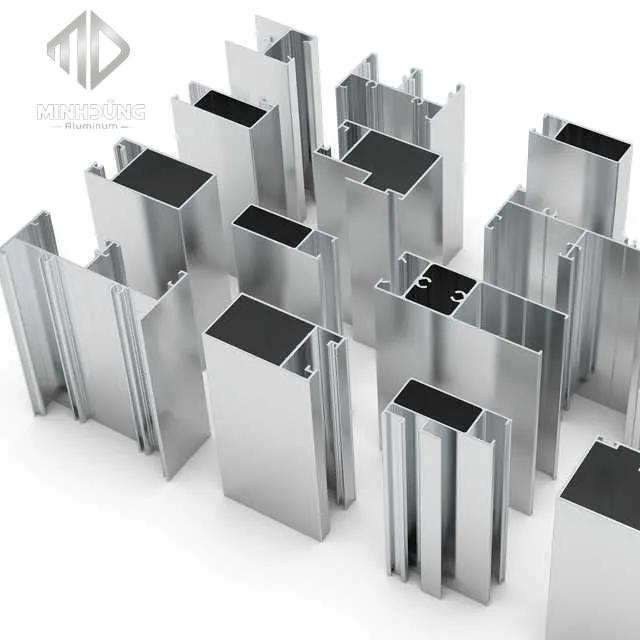
Stage 6: Artificial Ageing – Enhancing the Strength of Aluminium 6063
The artificial aging process plays a crucial role in increasing the hardness and stabilizing the mechanical properties of aluminum profiles, especially for 6063 alloy. After rapid cooling, the extruded profiles are placed in an aging furnace at 185°C – 205°C for several hours. Both temperature and time are strictly controlled to promote the precipitation of Mg₂Si, the key factor that determines the material’s strength.
During this process, the metal structure becomes more stable, allowing the aluminum to reach optimal hardness, improve load-bearing capacity, and minimize deformation during use. The factory will select the appropriate aging level:
- T5: Provides standard hardness, suitable for common construction applications such as aluminum doors, partitions, and light structural frames.
- T6: Offers higher hardness thanks to a more rigorous heat-treatment cycle, ideal for components requiring greater load capacity or operation in demanding environments.
Before moving on to surface finishing, all aluminum profiles undergo hardness and straightness inspections to ensure they meet technical standards.
Stage 7: Surface Finishing – Powder Coating & Anodizing
This final stage determines the corrosion resistance and long-term color stability of the product.
Anodizing: This process creates an artificial aluminium oxide layer that bonds tightly to the surface, typically 10–25 microns thick. Anodized aluminium is highly resistant to scratching and corrosion, making it ideal for coastal or high-humidity environments.
Powder Coating: Polyester or PVDF powder is electrostatical charged and sprayed onto the aluminium surface. The profiles are then cured at 200°C, producing a smooth, durable finish with excellent UV and weather resistance. Powder coating provides a wide range of colour options based on the RAL chart.
Final quality checks include:
- Measuring coating thickness
- Checking adhesion strength
- Inspecting colour consistency and gloss
- Protective packaging for transport

Conclusion
The production of aluminium profiles from Aluminium 6063 alloy is a highly controlled, multi-stage process—from billet selection, die design, and extrusion, to heat treatment and final finishing through Powder Coating or Anodizing. Every stage directly affects the product’s durability, precision, and appearance. A professional production system ensures not only technical accuracy but also long-term value for architectural projects and industrial applications.
If you need further technical support or pricing information, please feel free to contact:
Mia Ha – Export & Import Sales Department
Website: https://nhomminhdung.vn/
Email: kinhdoanh@nhomminhdung.vn
Hotline/WhatsApp: +84 332 008948
AluminiumProfiles #AluminiumExtrusion #6063Alloy #Anodizing #PowderCoating #IndustrialAluminum #ExtrusionFactory #AluminumManufacturer #MinhDungAluminum