In the non-ferrous metal industry value chain, aluminum billet plays a decisive upstream role. It directly affects extrusion efficiency and strongly influences the strength, durability, and stability of finished aluminum products.
In practice, high-quality billets help manufacturers reduce scrap, increase productivity, and maintain consistent quality in mass production.
1. What Is an Aluminum Billet?
An aluminum billet is a cylindrical aluminum casting made from primary aluminum or aluminum alloys. Manufacturers produce billets through melting, alloying, and casting processes such as Direct Chill Casting (DC Casting) or continuous casting.
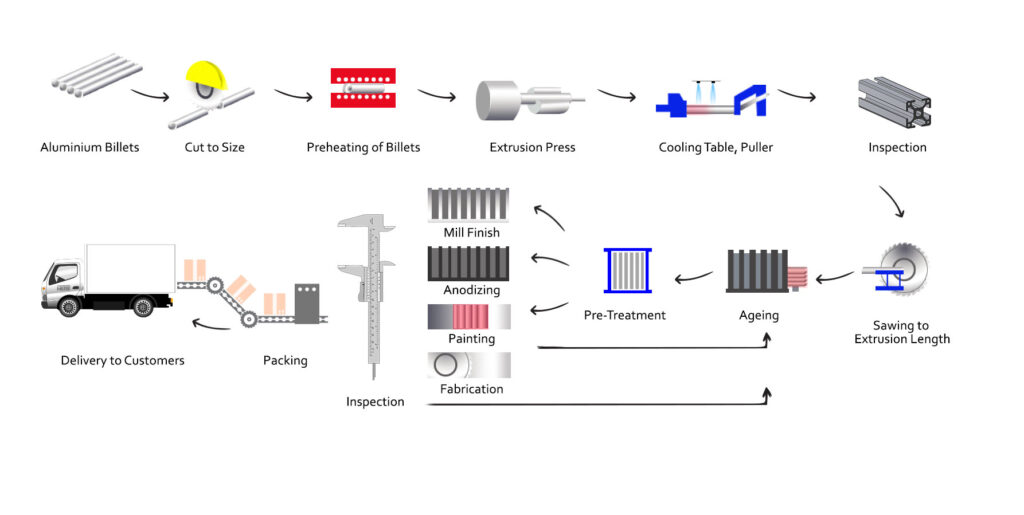
Most importantly, billets serve as the main raw material for aluminum extrusion. This forming process creates aluminum profiles for construction, transportation, electrical and electronic equipment, and industrial manufacturing.
2. Common Aluminum Billet Alloy Grades
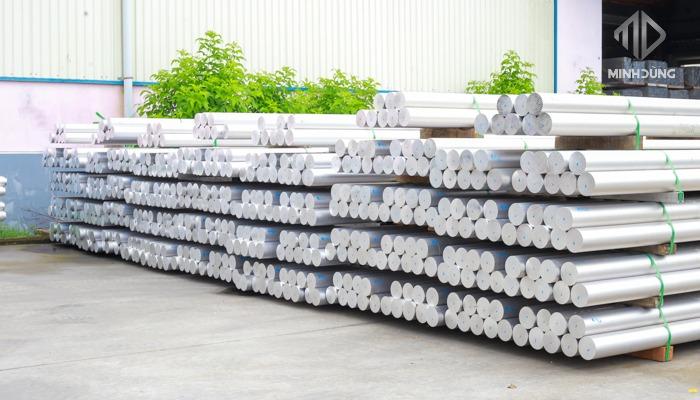
Manufacturers produce aluminum billets in various alloy grades to meet different technical and application requirements. Among these, the 6000 series is the most widely used due to its good extrudability and stable mechanical properties.
Aluminum Billet 6063 offers excellent formability and a smooth surface finish. As a result, it is widely used in architectural applications such as doors, windows, partitions, and curtain wall systems. This alloy is ideal for products with high aesthetic demands.
Aluminum Billet 6061, on the other hand, provides higher strength and better load-bearing capacity. Manufacturers often use it for machinery, industrial structures, and mechanical components. Compared to 6063, 6061 delivers better mechanical performance but a slightly lower surface finish quality.
Between these two, Aluminum Billet 6005 acts as an intermediate option. It suits structural systems and support frames that require higher strength than 6063 while maintaining stable extrusion behavior.
Therefore, choosing the right aluminum billet alloy from the beginning helps manufacturers control costs, improve efficiency, and ensure consistent product quality.
Choosing the right aluminum billet alloy from the beginning helps manufacturers optimize costs, improve production efficiency, and ensure consistent product quality.
3. Aluminum Billet Production Process
3.1. Melting and Alloying
First, the production process begins with melting raw aluminum in industrial furnaces. Manufacturers heat the aluminum until it reaches a stable molten state. This allows precise control of metal quality and composition.
Next, alloying elements such as magnesium (Mg), silicon (Si), or manganese (Mn) are added according to the selected alloy grade. This step directly determines billet strength, hardness, and extrusion performance.
Throughout this stage, technicians continuously monitor the chemical composition. As a result, good control at this early phase helps reduce defects and ensures stable quality in later processes.
3.2. Refining and Degassing
After melting and alloying, the molten aluminum enters the refining and degassing stage. At this point, manufacturers remove hydrogen gas and unwanted impurities from the metal.
If degassing is not sufficient, internal porosity or defects may appear inside the billet. These issues can reduce extrusion performance and affect final product quality. Therefore, proper refining produces cleaner and more stable molten aluminum.
Before casting, operators strictly control this process to ensure high metal purity.
3.3. Aluminum Billet Casting
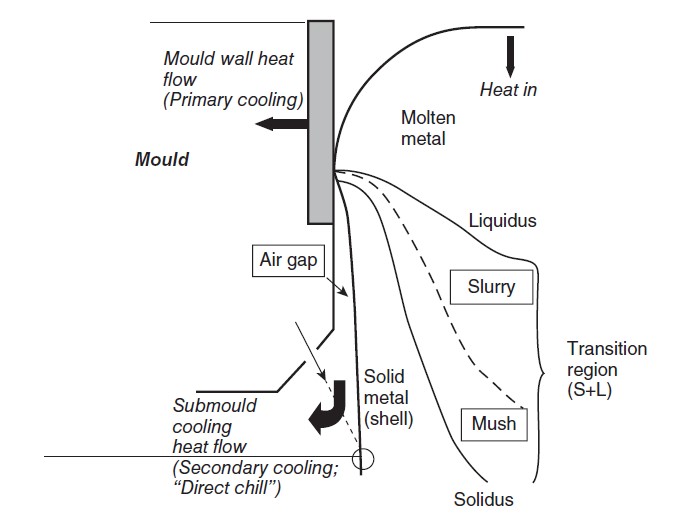
The rOnce refining is complete, manufacturers cast the molten aluminum into billets using Direct Chill Casting (DC Casting). This method is the most common in modern billet production.
During casting, controlled cooling solidifies the aluminum into cylindrical billets with a uniform internal structure. Proper cooling helps prevent cracking, distortion, and surface defects.
Afterward, operators inspect the billets for dimensions and surface quality. Only qualified billets move to the next heat treatment stage.
3.4. Homogenization
After casting, billets undergo homogenization heat treatment. During this process, manufacturers heat the billets at a controlled temperature for a specific time.
Homogenization evens out the alloy distribution between the billet core and surface. At the same time, it improves aluminum ductility. As a result, the billet becomes more stable during extrusion and allows smoother metal flow through the die.
Finally, manufacturers cool the billets under controlled conditions and cut them to standard lengths. Although this is the last step, homogenization plays a critical role in ensuring billet quality and consistency.
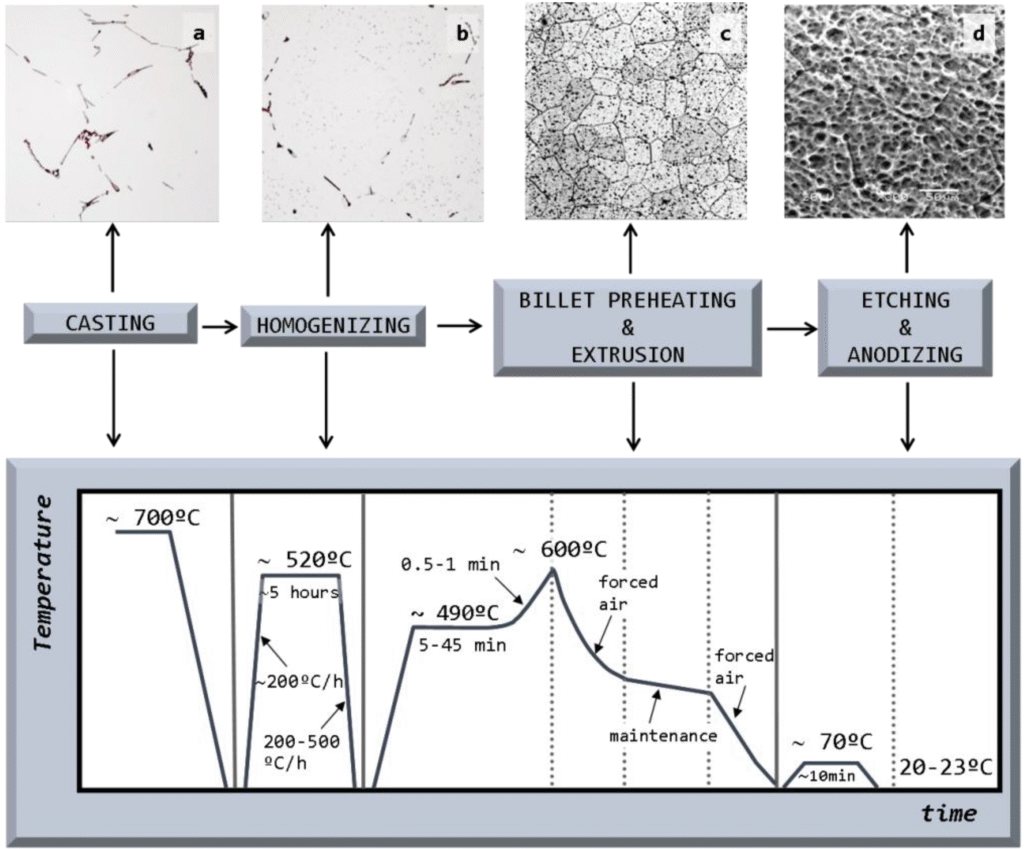
4. Why Is Aluminum Billet Ideal for Industrial Processing?
Aluminum billet is an ideal raw material for industrial manufacturing because it balances performance, cost, and production stability. Compared to other aluminum forms, billets offer uniform dimensions and controlled quality.
In addition, aluminum billet shows excellent deformation behavior when heated. This allows smooth metal flow through extrusion dies and supports the production of complex profiles. Such performance is essential for high-precision, large-volume manufacturing.
Standard billet sizes also help reduce material waste. As a result, manufacturers can optimize costs and improve overall production efficiency.
Moreover, controlled casting and heat treatment ensure consistent mechanical properties. This consistency is especially important for industrial and export-oriented applications.
5. Practical Applications of Aluminum Billet
Through extrusion and machining, aluminum billets become products used in many industries.
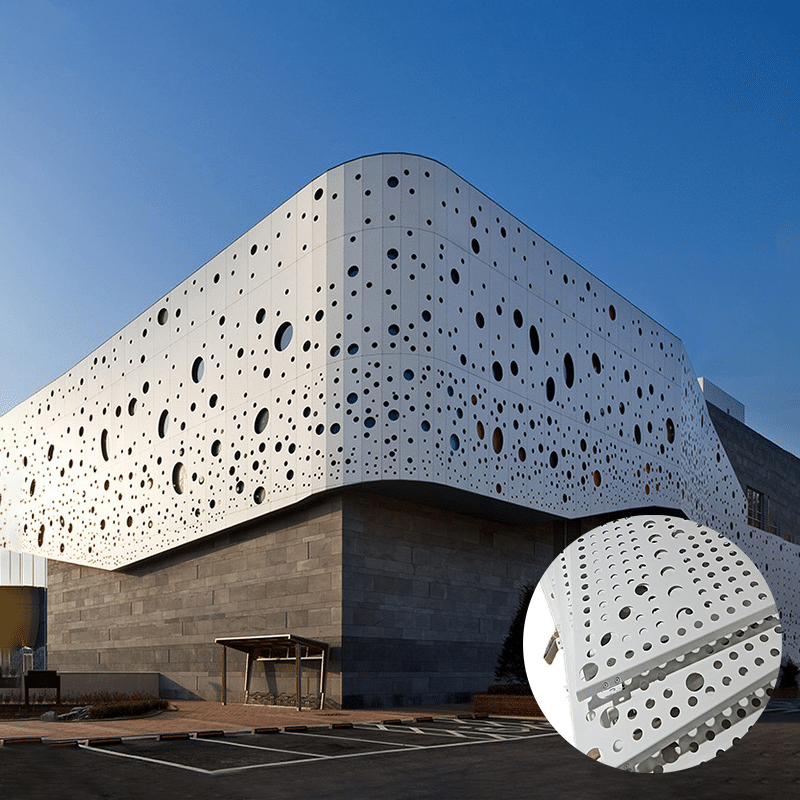
In construction and architecture, billets form the basis for aluminum doors, windows, curtain walls, partitions, and modern aluminum structures. These products combine durability, aesthetics, and corrosion resistance.
In transportation, manufacturers use aluminum billets to produce automotive parts, railway components, and lightweight structural elements. These applications help reduce weight, improve fuel efficiency, and enhance performance.
In addition, the energy sector relies on aluminum billets for solar panel frames, heat sinks, and electrical components. Precision engineering also uses billets for machine parts, fixtures, and industrial structures that require high strength and dimensional stability.
Conclusion
Aluminum billet is a core element in the industrial aluminum production chain. It directly affects product quality, production efficiency, and long-term stability.
From alloy selection to casting and heat treatment, each stage plays a vital role in meeting technical standards and processing requirements.
By using high-quality aluminum billets, manufacturers can reduce scrap, optimize costs, and achieve consistent performance in finished aluminum products. This advantage is crucial for meeting increasingly strict domestic and international market standards.
For more information about Aluminum Billet or to request technical support and quotations, please contact us:
Hà Linh Nhi – Sales Department
Website: https://nhomminhdung.vn
Email: kinhdoanh@nhomminhdung.vn
Hotline / WhatsApp: +84 332 008 948
You can also explore more related articles about aluminum billet, extrusion, and aluminum solutions on our website.