Many aluminum extrusion plants frequently encounter a common “pain point”. Specifically, while using the same 6063 aluminum billet, one batch runs smoothly with fast output, whereas another batch constantly suffers from pick-up, surface tearing, or fails to reach T6 hardness after aging. Consequently, the root cause is not the extruder’s skill. Instead, it lies in the metallurgical nature within the aluminum billet itself.
In reality, the 6063 standard represents a range rather than a fixed number. Therefore, applying a rigid formula for temperature and ram speed to every 6063 aluminum billet is a major mistake that leads to production losses. This article will break down the technical factors. As a result, plant managers and engineers can optimally adjust their extrusion parameters.
The Nature of the 6063 Alloy: The Difference Between “Lean” and “Rich”
The component that directly determines the hardness and extrudability of the 6063 aluminum billet is the Mg2Si precipitate (a combination of Magnesium and Silicon). Depending on this ratio, 6063 billets are divided into two groups with completely opposite characteristics.
1. Low Alloy Billet (Lean 6063)
- Composition characteristics: These are controlled at the lower limit of the standard. Typically, Mg is around 0.40% – 0.45%, and Si is around 0.35% – 0.40%.
- Extrusion behavior: Because the amount of Mg2Si precipitate is low, the flow stress (the metal’s resistance) is very small. Consequently, the metal flow through the die bearing is extremely smooth with low friction.
- Operational strategy:
- Firstly, you can heat the billet to a high standard level (440°C – 460°C).
- Secondly, this allows you to push the extrusion speed to the maximum. You can do this without worrying about the Exit Temperature crossing the danger threshold and damaging the surface.
2. High Alloy Billet (Rich 6063)
- Composition characteristics: These are pushed to the upper-middle or upper limits. Normally, Mg ranges from 0.55% – 0.65%, and Si ranges from 0.45% – 0.55%.
- Extrusion behavior: Furthermore, the dense Mg2Si concentration gives the metal a massive deformation resistance. Thus, forcing this dense metal through the die generates a massive amount of frictional heat.
- Operational strategy:
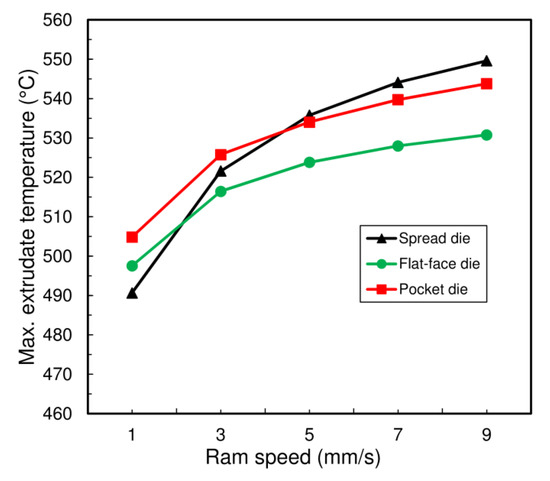
- You must strictly slow down the extrusion speed. If you run it as fast as a Lean billet, the accumulated frictional heat will push the aluminum profile’s temperature past 540°C – 550°C. Ultimately, this breaks the surface structure, causing pick-up or coarse grains.
- Technicians often have to pre-heat the billet to a lower temperature (420°C – 440°C). This action creates a safe “buffer” to absorb the generated frictional heat.
The Role of Homogenization and Iron (Fe) Impurities
Besides the Mg and Si ratio, two other “invisible” factors determine the extrusion speed. These are Iron (Fe) impurities and the billet’s homogenization level.
- Iron (Fe) Impurities: If the Fe content is high or poorly controlled, the aluminum grain structure becomes coarse. As a result, friction in the die chamber will skyrocket. (Note for SEO: You can link to an external source here, like: Learn more about Aluminum 6063 properties on Wikipedia)
- Homogenization quality: A precisely homogenized 6063 aluminum billet will break the as-cast crystal structure and evenly disperse the Mg2Si. Thanks to this, the factory can extrude at a lower temperature but at a faster speed. Conversely, a poorly homogenized billet strictly requires very slow extrusion to allow enough time for the compounds to dissolve.
Optimal Technical Tip: Applying Isothermal Extrusion
A vital principle in aluminum extrusion is controlling the Exit Temperature. It must always stay within the “sweet spot” of 500°C – 530°C.
- If < 500°C: There is not enough heat to dissolve Mg2Si into a solid solution. Even after passing through the quenching system and aging oven, the aluminum profile still will not achieve the required hardness.
- If > 540°C: Overheating directly leads to surface blistering and profile tearing.
The Excess Silicon Solution: To solve the problem of wanting both easy extrusion and high hardness, modern billet casters apply an excess silicon ratio (for instance, 0.45% Mg combined with 0.45% Si). Ultimately, this surplus Si significantly increases hardness in the aging oven without increasing friction during extrusion. Thus, it helps the factory maintain an optimal output speed.
Choosing a Quality 6063 Aluminum Billet Supplier
Adjusting the extrusion speed and temperature becomes meaningless if the input 6063 aluminum billet lacks stability between batches. Continuous variations in alloy composition will leave extrusion engineers “blind to parameters” and increase the defect rate.
At Minh Dung Holdings (MD Holdings), we provide Green Billet 6063 lines with strict metallurgical control. Every billet batch is precisely balanced in the Mg/Si ratio, strictly controls Fe content, and undergoes an internationally standardized homogenization process. Therefore, choosing a stable aluminum billet is the definitive key to protecting your die system, maximizing extrusion speed, and increasing your factory’s profit margin.
Contact: Kevin Nguyen
Phone number: +84 373486 719