Why Source Aluminum Heat Sinks fromVietnam Instead of China?
SEO title (≤60 chars): Aluminum Heat Sinks: Why Source from Vietnam, Not China
Meta description (≤155 chars): Chinese heat sinks face anti-dumping duties of up to 86% in the US, plus surtaxes in Canada and the EU. See the data behind sourcing from Vietnam in 2026.
URL slug: /blog/aluminum-heat-sinks-vietnam-vs-china ·
Focus keyword: aluminum heat sink manufacturer Vietnam ·
Secondary: extruded heat sink supplier, China+1 aluminum extrusion, heat sink anti-dumping duty
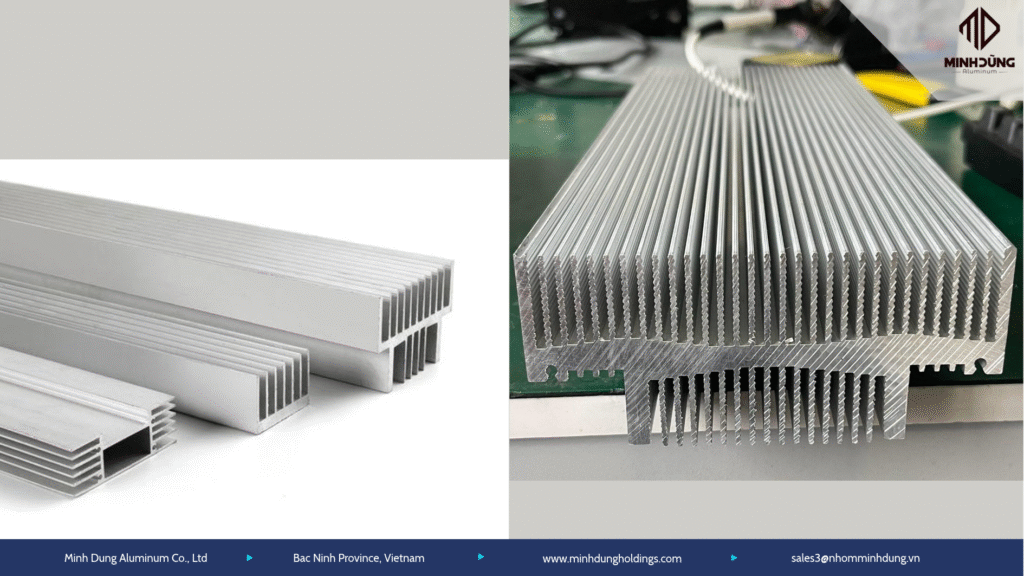
Image file: vietnam-aluminum-heat-sink-hero.png · alt: Extruded aluminum heat sink – Vietnam vs China sourcing 2026
For most buyers in North America and Europe, a Vietnam-made aluminum heat sink now lands cheaper and with less compliance risk than a Chinese one. The reason is not the factory price. It is the stack of duties that applies only to Chinese-origin aluminum extrusions, and the paperwork now needed to prove where the metal was smelted and cast.
China still runs the world’s largest extrusion industry. But since 2024, rules in Washington, Ottawa and Brussels have shifted the total landed cost. This article sets out the numbers: market size, duty rates by market, cost of labor, and the traceability rules. It also says when China is still the better choice, and how to vet a supplier in Vietnam.
A growing market built on extruded aluminum
Heat sinks are a USD 7–10 billion market, and aluminum is the main material. Estimates differ by research firm. Mordor Intelligence puts the market at USD 7.34 billion in 2025, growing to USD 10.37 billion by 2031, with aluminum holding 45.63% of it. Fortune Business Insights gives a higher figure: USD 9.55 billion in 2025, reaching USD 19.06 billion by 2034 at a 7.5% CAGR.
The extruded segment matters most for sourcing. Polaris Market Research found that extruded heat sinks held 35.42% of the market in 2025, the largest share of any type. Demand comes from EV power electronics, solar inverters, LED lighting, telecom and data-center hardware.
The alloy choice explains why extrusion leads. 6063 is the standard heat-sink alloy: around 210 W/m·K in T5 temper and 200 W/m·K in T6. It extrudes easily into thin, dense fins. 6061-T6 conducts less heat (about 170 W/m·K) but is stronger, so it suits heat sinks that also carry a load. Copper conducts about twice as well, at roughly 3 times the weight and a much higher metal price. For most designs, a well-designed 6063 extrusion gives the best balance of performance and cost.
| Alloy / temper | Thermal conductivity (W/m·K) | Best use |
| 6063-T5 | ~210 | Standard fin profiles, LED, electronics enclosures |
| 6063-T6 | ~200 | Higher-strength fin profiles |
| 6061-T6 | ~170 | Structural or load-bearing heat sinks |
| Copper (C110) | ~390 | Hot spots, compact high-flux parts |
Reason 1: Chinese extrusions carry trade-remedy duties; Vietnamese ones do not
The biggest gap between the two origins is trade-remedy duty. All three major Western markets have duties on Chinese aluminum extrusions. None has equivalent duties on extrusions from Vietnam.
United States. Anti-dumping (AD) and countervailing (CVD) orders on Chinese aluminum extrusions have applied since May 26, 2011. Heat sinks are named in the scope. Only “finished heat sinks” that meet a strict exclusion test fall outside it; heat sink blanks and fabricated heat sinks remain subject. The China-wide AD rate is 86.01%, on top of the CVD deposit.
Vietnam was investigated too. In 2024 the Department of Commerce found dumping by 14 countries, Vietnam included. But on October 30, 2024, the US International Trade Commission found no injury to the US industry, so no orders were issued. The US Court of International Trade later upheld that decision.
Canada. On October 1, 2025, the Canadian International Trade Tribunal continued AD and CVD duties on Chinese aluminum extrusions. Since July 2025, Canada also charges a 25% surtax on aluminum goods that contain aluminum smelted and cast in China. Vietnam is a CPTPP member, so qualifying Vietnamese extrusions enter Canada duty-free with a CPTPP certificate of origin.
European Union. Brussels has imposed AD duties of 21.2% to 32.1% on Chinese extrusions since March 31, 2021. They were due to lapse in March 2026, but the Commission opened an expiry review on March 27, 2026, so they stay in force while it runs. Under the EU–Vietnam Free Trade Agreement, the EU has now cut duties on about 99% of tariff lines for Vietnamese goods to zero.
Reason 2: the US tariff stack favors Vietnam by 100+ points
In the US, a Chinese extruded heat sink pays at least 111 percentage points more duty than the same part from Vietnam. Some layers apply to both origins. Others apply only to China.
| US duty layer (Nov 2026) | China origin | Vietnam origin |
| Section 232 aluminum (50% on full value for heading 7604 articles) | Yes | Yes |
| Section 301 forced-labor tariff (12.5% tier, since July 24, 2026) | 12.5% | 12.5% |
| Section 301 China tariff on aluminum products (raised to 25% in 2024) | 25% | 0% |
| AD order on aluminum extrusions (China-wide rate) | 86.01% | 0% |
| CVD order on aluminum extrusions | Company-specific | 0% |
| Origin-specific gap | 111+ points | 0 |
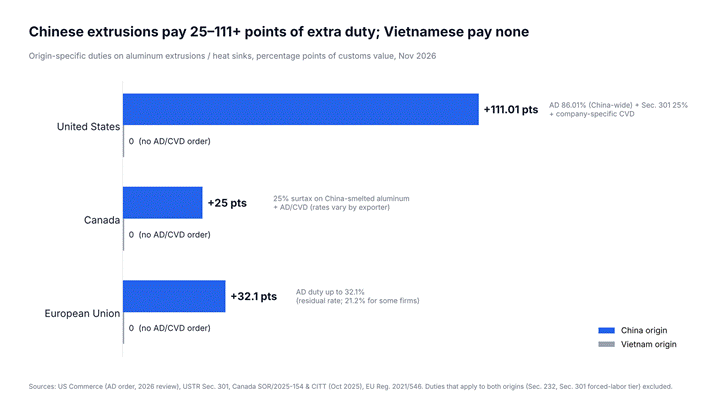
Image file: heat-sink-duty-china-vs-vietnam-2026.png · alt: Anti-dumping and surtax duties on Chinese vs Vietnamese aluminum heat sinks, 2026
The layers Vietnam shares with China do not change the comparison. The extra 111 points on Chinese goods do. Even if a Chinese factory quotes 20–30% below a Vietnamese one, the duty gap wipes out that saving many times over.
Two cautions apply. First, exact rates depend on the HTS code: an extrusion (7604) and a finished heat sink (often chapter 84 or 85) are treated differently, so ask a customs broker to confirm your classification. Second, the IEEPA “reciprocal” tariffs were struck down by the Supreme Court on February 20, 2026. US tariffs can change quickly, but the AD/CVD orders and the China Section 301 tariffs have lasted through every change since 2018.
Reason 3: “smelted and cast” origin now decides the duty
Customs now looks at where the metal was made, not only where the part was shipped from. Canada’s rule is the clearest example. Goods are deemed to contain Chinese-smelted aluminum if the importer cannot produce a certificate proving otherwise, and they then pay the 25% surtax. The US Section 232 regime likewise asks importers to declare the country of smelt and cast.
This closes the old shortcut of shipping Chinese extrusions, or extrusions made from Chinese billet, through a third country. A heat sink extruded in Vietnam from imported Chinese billet can still fail an origin test. For a buyer, the questions that matter are:
- Where was the primary aluminum smelted?
- Where was the billet cast?
- Can the supplier prove both on a mill certificate, heat by heat?
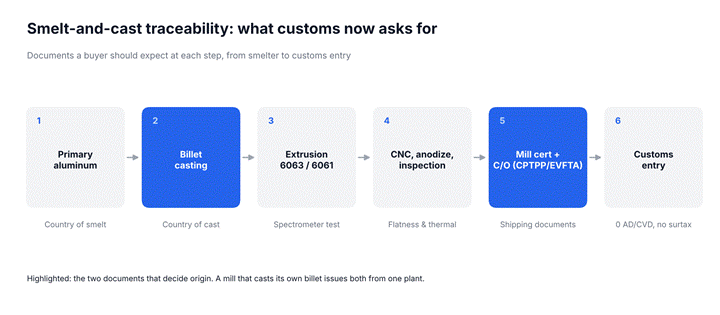
Image file: aluminum-smelt-and-cast-traceability.png · alt: Aluminum smelt-and-cast traceability steps for heat sink imports
A Vietnamese mill that casts its own billet can answer all three with documents. That is the real value of an integrated supplier: the extrusion, the billet and the paperwork come from one plant.
Reason 4: the factory-price gap with China has narrowed
China’s price edge on aluminum semis is smaller than it was two years ago. On December 1, 2024, Beijing cancelled the 13% export tax rebate on aluminum products. ING expected the change to make Chinese aluminum more expensive on world markets.
Labor costs also favor Vietnam. Boston Consulting Group put average hourly labor cost at US$6.5 in China versus US$3 in Vietnam in 2020. Vietnam’s official data show manufacturing workers earned about US$349 a month in 2024. Extrusion is capital-heavy, so labor is a smaller share of cost than in assembly. It matters most in the labor-heavy steps of heat sink work: CNC machining, cutting, deburring, anodizing and inspection.
Reason 5: an electronics supply chain that needs thermal parts
Vietnam is now one of the world’s largest electronics exporters, which means heat sink demand and know-how sit close by. Exports of computers, electronics and components reached US$107.75 billion in 2025, and shipments to the US rose 81.4% to US$42.09 billion. Manufacturing drew about US$18.22 billion of FDI in the first ten months of 2025, nearly 60% of the total.
For a buyer, this means a Vietnamese extruder may already ship to the same inverter, LED or EV-charger makers you supply. It also means local anodizers, CNC shops and packaging suppliers are in place, so lead times do not depend on one plant.
When China may still be the better choice
Vietnam is not the answer for every heat sink. China still leads in a few cases:
- Specialist processes. Skived fins, bonded-fin assemblies, vapor chambers and heat pipes are more widely available in China. Many Vietnamese mills focus on extruded profiles plus CNC finishing.
- Very wide or very complex dies. China has more large-press capacity for wide, high fin-ratio profiles. Check each supplier’s press tonnage and circle size against your drawing.
- Markets with no duty on Chinese extrusions. If you sell mainly into Asia, the duty gap above may not apply.
- Volume shocks. China’s industry can absorb large, sudden orders. In Vietnam, plan capacity with your supplier ahead of time.
In practice, many buyers run a China+1 model: Vietnam supplies the parts bound for the US, Canada and EU, while China keeps specialist work. The aim is lower duty risk, not one country for everything.
How to qualify a Vietnamese heat sink supplier
A low quote means little if the origin fails at customs or the fins fail a thermal test. Check these seven points before you place a first order:
- In-house billet casting. Ask where the billet comes from. A mill that casts its own billet controls both chemistry and origin.
- Mill certificate showing country of smelt and cast. It should be traceable to the cast lot.
- Certificate of origin for your market. CPTPP for Canada, Mexico and Australia; EVFTA for the EU.
- Alloy control. Spectrometer testing of each cast, with results on file. Tight Mg and Si ranges in 6063 keep thermal conductivity stable.
- Die and press capability. Press tonnage, maximum circle size, the thinnest fin and the highest fin ratio already made.
- Secondary operations in one plant. CNC milling, drilling, tapping, anodizing and flatness checks, so there are no hand-offs between suppliers.
- Low-carbon data. Recycled content and CO₂ per kilogram are now asked for in EU and OEM tenders.
Order a sample run against your drawing, then test thermal resistance and flatness on the samples before you approve a die for production.
Frequently asked questions
Are aluminum heat sinks from Vietnam subject to US anti-dumping duty? No. The 2024 US investigation covered Vietnam, but the ITC found no injury, so no AD or CVD order exists on Vietnamese aluminum extrusions.
Are Chinese heat sinks always covered by the US order? Not always. Finished heat sinks that meet the exclusion test are outside the order. Heat sink blanks and fabricated heat sinks are inside it. Ask for a scope ruling if you are unsure.
Can a Vietnamese supplier use Chinese billet? It can, but then the goods may count as containing Chinese-smelted aluminum in Canada and may draw circumvention scrutiny in the US. Ask for the country of smelt and cast on the mill certificate.
Which alloy is best for an extruded heat sink? 6063-T5 for most designs, because it combines about 210 W/m·K with easy extrusion of thin fins. Use 6061-T6 when the part also has to carry a load.
Conclusion: lower duty risk, documented origin
Vietnam wins on landed cost for most heat sinks sold into the US, Canada and EU. The data points the same way in each market. Chinese extrusions pay AD/CVD and surtaxes there; Vietnamese ones do not. And Vietnam’s FTAs remove most remaining duties. The condition is proof of origin: buy from a mill that casts its own billet and puts the smelt-and-cast country on every certificate.
Minh Dung Aluminum casts its own billet in Vietnam and runs 6 extrusion lines with about 40,000 tonnes of annual capacity. We extrude 6063, 6061, 6005/6005A and 6082 profiles to your drawing, with anodizing, powder coating and CNC machining in-house. Every shipment comes with a mill certificate showing where the metal was smelted and cast, spectrometer test records and a certificate of origin, including CPTPP. We already export to the US, Canada, Mexico, the EU and Australia.
Send us your heat sink drawing (alloy, finish and annual volume) for a quote and samples.
Sources
- US Department of Commerce, AD order on aluminum extrusions from China (2011) and 2026 administrative review
- USITC, negative final determination, 14 countries (Oct 30, 2024)
- CITT, continuation of order on Chinese extrusions (Oct 1, 2025)
- Government of Canada, Steel Goods and Aluminum Goods Surtax Order
- European Commission, AD duties on Chinese extrusions (2021)
- EY, Section 232 proclamation of April 2, 2026
- Vietnam Customs via VTV, 2025 electronics exports
- Mordor Intelligence, Heat sinks market
Duty rates as of November 28, 2026. Rates change often; confirm your HTS classification with a licensed customs broker.