As manufacturers across automotive, aerospace, transportation, and industrial engineering continue to pursue lighter and more efficient products, aluminum has become an increasingly important engineering material.
But using aluminum is not simply about choosing a lightweight metal. For components exposed to high loads, vibration, impact, or repeated stress, the manufacturing process can have a major influence on the final performance of the part.
This is where aluminum forging stands out.
By applying controlled pressure to heated aluminum billet, forging can produce components with excellent strength-to-weight ratios, fatigue resistance, toughness, and structural reliability. However, the performance of a forged component depends on more than the forging process itself. Alloy selection, billet quality, heat treatment, forging temperature, and process control all play important roles.
So, what makes aluminum forging suitable for demanding applications, and which aluminum alloys are best for forging?
What Is Aluminum Forging?
Aluminum forging is a manufacturing process in which an aluminum billet or preform is heated and shaped through controlled compressive forces.
Unlike machining, which removes material to achieve the desired shape, forging deforms the aluminum into the required geometry. The controlled deformation can influence the material’s internal structure and grain flow, helping produce components with high mechanical performance and structural integrity.
Two common approaches are open-die forging and closed-die forging.
Open-Die Forging
In open-die forging, the aluminum billet is compressed between dies that do not completely enclose the material.
This method is generally suitable for relatively simple shapes, larger components, and applications where flexibility in component dimensions is important.
Closed-Die Forging
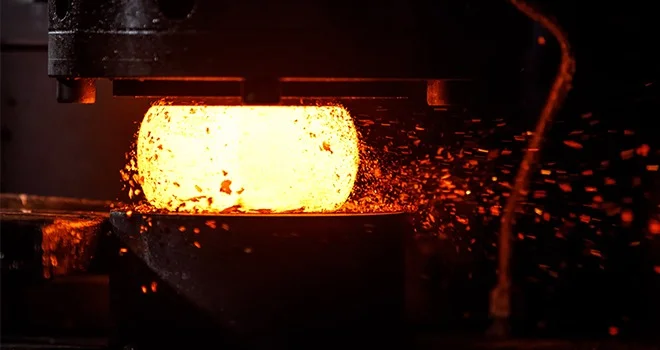
Closed-die forging uses dies containing the desired component geometry. The heated billet is compressed inside the die cavity, allowing manufacturers to produce more complex shapes with greater dimensional control.
This process is particularly useful for high-volume production of engineered components where repeatability and mechanical performance are critical.
Why Does the Starting Billet Matter?
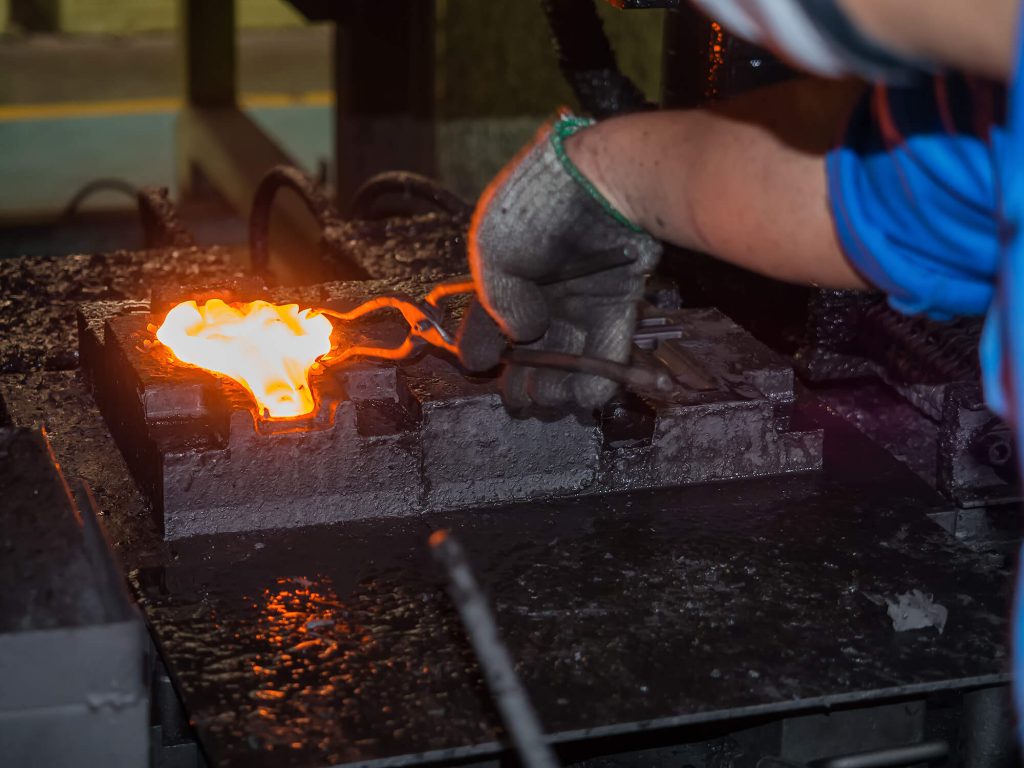
The quality of the final forged component begins before the billet enters the forging press.
Chemical composition, alloy consistency, homogeneity, internal quality, billet dimensions, and heating conditions can all influence how the material behaves during deformation.
A billet with inconsistent chemistry or internal defects can create problems later in the manufacturing process, even when the forging operation itself is carefully controlled.
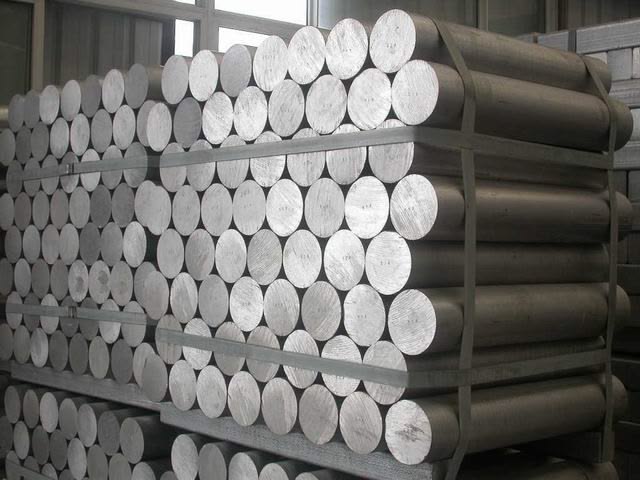
For this reason, high-quality aluminum billet is a fundamental part of reliable forging production.
Best Aluminum Alloys for Forging Applications
There is no single “best aluminum alloy for forging.”
The right alloy depends on what the component needs to withstand, including mechanical loads, fatigue, corrosion, temperature, machining requirements, and operating environment.
Several aluminum alloys are particularly relevant for demanding forging applications.
6061 Aluminum
6061 aluminum is one of the most versatile heat-treatable aluminum alloys.
It provides a practical balance of:
- Strength
- Corrosion resistance
- Machinability
- Weldability
- General versatility
This balance makes 6061 suitable for a broad range of engineering applications where manufacturers need reliable mechanical performance without moving to a more specialized high-strength alloy.
For many forging applications, 6061 can be an attractive choice when overall performance and manufacturability need to be balanced.
6082 Aluminum
6082 aluminum is known for its relatively high structural strength within the 6000 series.
It is commonly considered when components require greater mechanical performance for demanding engineering applications.
Compared with more general-purpose grades, 6082 can be particularly useful for structural and load-bearing applications where strength is an important design requirement.
Its combination of strength and practical machinability makes it a relevant option for industrial engineering and transportation components.
7075 Aluminum
When very high strength is the primary requirement, 7075 aluminum is one of the most important alloys to consider.
It is widely associated with aerospace and other high-performance applications where strength-to-weight performance is critical.
However, its higher strength comes with trade-offs. Corrosion behavior, processing conditions, heat treatment, and application environment require greater attention than with more general-purpose alloys.
7075 should therefore be selected because its overall performance matches the application, not simply because it has a higher nominal strength.
2014 Aluminum
2014 aluminum offers high strength combined with good machinability and is associated with demanding engineering and aerospace applications.
It can be considered when a component requires a high level of mechanical performance and will undergo significant machining after forging.
As with other high-strength alloys, manufacturers need to consider the complete processing route, including forging conditions and heat treatment, rather than evaluating the alloy based on strength alone.
2024 Aluminum
2024 aluminum is particularly well known for its strength and fatigue performance.
Its established use in aerospace applications reflects the importance of these properties in components exposed to repeated loading and demanding service conditions.
However, corrosion considerations are important when selecting 2024, particularly for components exposed to aggressive environments.
Aluminum Forging Alloy Comparison
| Alloy | Main Strength | Corrosion Resistance | Typical Applications |
| 6061 | Balanced mechanical performance | Good | General engineering, transportation, machinery |
| 6082 | Higher structural strength | Good | Structural and demanding engineering parts |
| 7075 | Very high strength | Moderate; requires attention | Aerospace, high-performance components |
| 2014 | High strength and machinability | Lower than general-purpose 6000 series | Aerospace, demanding engineering |
| 2024 | Strength and fatigue performance | Requires protection in demanding environments | Aerospace and transportation |
The table provides a general comparison rather than a universal ranking. Actual performance depends on temper, heat treatment, forging temperature, component geometry, and service conditions.
How to Choose the Right Aluminum Alloy for Forging
Choosing an alloy based only on its tensile strength can lead to the wrong material decision.
Instead, manufacturers should start with the actual requirements of the finished component.
When maximum strength is the priority
High-strength alloys such as 7075, 2014, or 2024 may be considered when the component faces demanding mechanical loads.
However, higher strength may introduce trade-offs in corrosion resistance, processing, cost, or machinability.
When balanced performance is required
6061 can be a practical option when manufacturers need a combination of strength, corrosion resistance, machinability, and versatility.
When structural strength is important
6082 is worth considering for components where higher structural performance is required while retaining the advantages associated with the 6000 series.
Consider fatigue loading
For components subjected to repeated loading, fatigue performance should be evaluated rather than relying solely on static strength values.
This is particularly important in aerospace, automotive suspension, transportation, and rotating machinery applications.
Consider the operating environment
Will the component be exposed to:
- Moisture?
- Salt or marine environments?
- High temperatures?
- Repeated vibration?
- Impact?
- Chemicals?
The operating environment can significantly influence alloy selection and the need for additional surface protection.
Consider machining requirements
Some forged components require substantial machining after forging.
An alloy that provides excellent mechanical performance but creates unnecessary machining difficulties may not be the most economical choice.
The best alloy is therefore the one that provides the required combination of strength, fatigue performance, corrosion resistance, manufacturability, and cost for the specific component.
Common Applications of Aluminum Forging
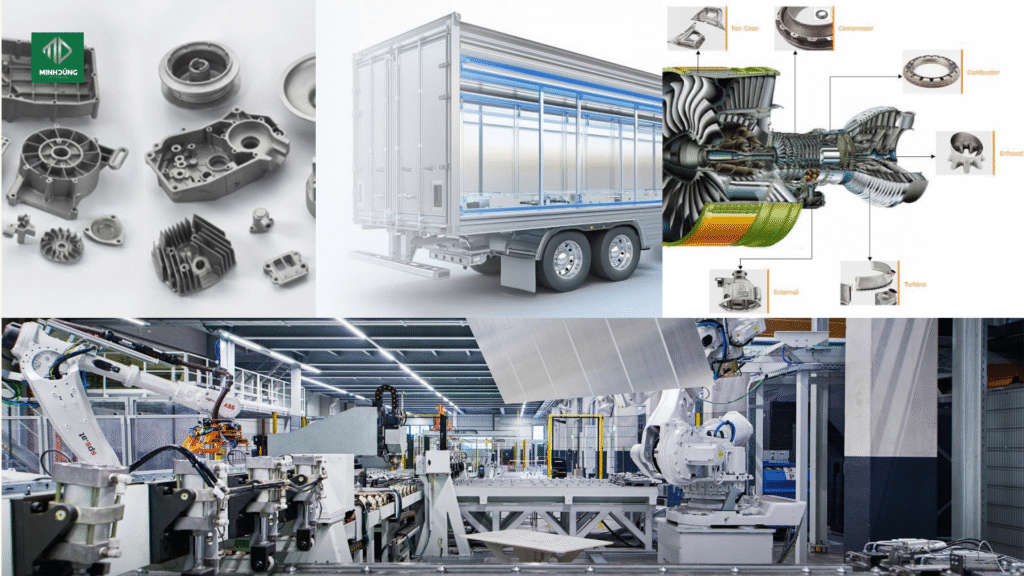
The advantages of forged aluminum are particularly valuable in industries where weight, strength, and reliability must be considered together.
Automotive and EV Components
Automotive manufacturers use lightweight aluminum components to improve vehicle efficiency while maintaining mechanical performance.
Potential applications include:
- Suspension components
- Steering components
- Structural parts
- Wheel-related components
- EV components
- High-load mechanical parts
For electric vehicles, weight reduction is especially valuable because lower vehicle mass can support energy efficiency and driving range.
Aerospace Components
Aerospace is one of the most demanding applications for aluminum forging.
Aircraft components must be lightweight while maintaining high structural reliability under repeated loading.
Forged aluminum can therefore be used for components such as structural fittings, brackets, landing-related components, and other high-performance parts.
Alloy selection is particularly important in this sector because mechanical performance, fatigue, corrosion, weight, and certification requirements must be considered together.
Industrial Machinery
Industrial equipment often requires components capable of handling repeated mechanical loads.
Forged aluminum can be used for machinery components where lightweight construction and structural performance provide an advantage.
Typical examples include mechanical components, brackets, housings, and load-bearing parts.
Transportation and Structural Applications
Beyond automotive and aerospace, forged aluminum can also be relevant to transportation and engineering systems where reducing weight while maintaining durability is important.
The exact application determines whether forging offers a meaningful advantage over extrusion, casting, machining, or other manufacturing methods.
Aluminum Forging vs. Casting and Extrusion
Forging is not automatically better than every other aluminum manufacturing process.
Each process is designed for different requirements.
| Factor | Forging | Casting | Extrusion |
| Strength | High potential | Depends on alloy and casting process | Good to high |
| Shape | Complex 3D components | Very complex shapes possible | Long continuous profiles |
| Material flow | Controlled deformation | Molten metal solidifies in mold | Material flows through die |
| Typical products | Structural components | Complex housings and shapes | Profiles and sections |
| Best suited for | High loads and fatigue | Complex geometry | Long consistent cross-sections |
| Production considerations | Tooling and forming force | Mold and casting control | Die and extrusion conditions |
Forging vs. Casting
Casting is often preferred when a component has a highly complex shape that would be difficult or uneconomical to forge.
It allows molten aluminum to fill a mold and create complex geometries.
Forging, however, is often preferred when strength, fatigue resistance, and structural reliability are the dominant requirements.
Forging vs. Extrusion
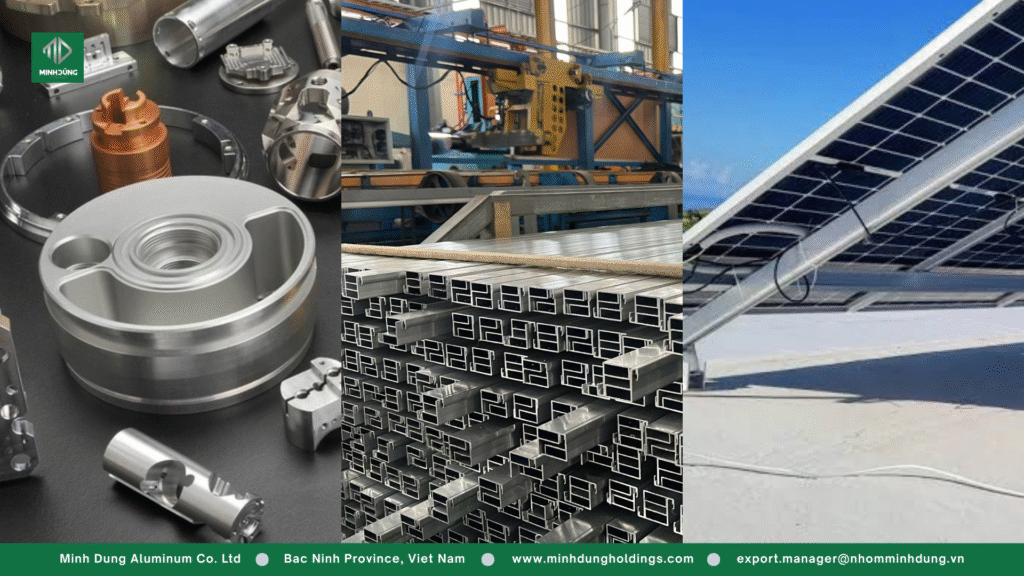
Extrusion is ideal for products with a continuous cross-section, such as tubes, channels, rails, frames, and architectural profiles.
Forging is more appropriate for compact components with complex three-dimensional geometry and demanding mechanical requirements.
The right choice therefore begins with the design of the component, not with the assumption that one process is universally superior.
Factors That Determine the Quality of Forged Aluminum Components
Selecting the correct alloy is only the beginning.
Several factors determine whether the final forged component meets its intended performance.
1. Aluminum Billet Quality
The billet is the starting point of the forging process.
Consistent billet quality helps provide predictable behavior during heating, deformation, and heat treatment.
Poor-quality billet can introduce problems that cannot always be corrected during forging.
2. Chemical Composition
The alloy’s chemical composition must remain within the required specification.
Even relatively small variations in alloying elements can influence strength, corrosion resistance, machinability, and heat-treatment response.
For this reason, chemical analysis and batch consistency are essential parts of billet quality control.
3. Homogeneity
A billet should have a consistent internal structure and composition.
Good homogeneity supports more predictable deformation and helps reduce variation between forged components.
This is particularly important for manufacturers operating large-volume production.
4. Heating and Forging Temperature
Temperature directly affects aluminum’s ability to deform.
If the billet is not heated appropriately, forging may become more difficult and defects can occur. Excessive or poorly controlled temperatures can also negatively affect material behavior.
Precise temperature control is therefore an important part of the forging process.
5. Die Design
Die geometry determines how material flows during forging.
A properly designed die helps control material distribution, minimize defects, and achieve the required component geometry.
For complex components, die design and process simulation can be particularly important.
6. Heat Treatment
Many aluminum forging alloys rely on heat treatment to achieve their required mechanical properties.
The final performance of an alloy such as 6061, 6082, 7075, 2014, or 2024 depends not only on its nominal composition but also on the appropriate temper and heat-treatment condition.
7. Machining and Inspection
Forged components often require machining to achieve final dimensions and tolerances.
Inspection is then used to verify dimensional accuracy and product quality.
Depending on the application, manufacturers may require chemical analysis, dimensional inspection, mechanical testing, or other quality-control procedures.
Conclusion
Aluminum forging offers an effective combination of low weight, strength, durability, and structural reliability, making it an important manufacturing solution for automotive, aerospace, transportation, and industrial applications.
However, choosing the strongest available alloy is not necessarily the right answer.
6061 provides a balanced combination of strength, corrosion resistance, and machinability. 6082 is attractive for higher structural strength. 7075 offers very high strength for demanding high-performance applications, while 2014 and 2024 are important options for specific high-strength and aerospace requirements.
The right choice ultimately depends on the complete performance requirements of the finished component—including loading conditions, fatigue, corrosion environment, machining requirements, weight targets, and heat treatment.
Just as importantly, the quality of the aluminum billet should never be overlooked. Consistent chemical composition, homogeneity, suitable dimensions, and controlled metallurgical quality provide the foundation for a reliable forging process.
Need Aluminum Billet for Forging Applications?
Minh Dung Aluminum supplies aluminum billet for demanding downstream manufacturing applications, including forging. Available alloys include 6061, 6063, 6005 and other customized compositions according to customer requirements.
Our billet production focuses on controlled alloy composition and consistent quality, supporting manufacturers looking for a reliable aluminum feedstock for further processing.
Whether you require a specific alloy, billet diameter, chemical composition, or customized specification, our team can discuss your technical and supply requirements.
Contact Mai Tran – Export Sales
📞 WhatsApp: +84 949 000 701
📧 export@nhomminhdung.vn