Vietnam’s competitive advantage over China in aluminum is not simply a result of subsidies or low labor costs. It is driven by the different U.S. tariff structures applied to the two countries, combined with Vietnam’s upstream capacity and FTA network built over the past decade.
Since the U.S. added further layers of Section 301, Section 232 and Section 122 tariffs on Chinese goods during 2024-2026, industrial aluminum sourcing has fundamentally changed. For aluminum billet and aluminum profile importers, the question is no longer “which country is cheaper?” but “which country is not taxed like China?” Vietnam answers that question-not because it receives preferential treatment, but because its products do not have the Chinese origin targeted by those U.S. trade measures.
Vietnam has become an alternative sourcing destination to China, based on tariff data, legal records and publicly available investment data through August 2026. The final section covers compliance risks that every buyer should review before signing a long-term contract.
1. Vietnam Aluminum Does Not Carry China-Specific Punitive Tariffs
U.S. imports can currently face up to three cumulative tariff layers:
- Section 301 – China-origin punitive tariff, 7.5%-100% depending on the HS code
- Section 232 – national-security tariff applied by material type regardless of origin, currently 50% for products made entirely or almost entirely of aluminum
Key point: Section 301 applies only to goods of Chinese origin. Vietnamese aluminum does not face this layer-not because of an exemption, but because it is legally outside its scope. For products classified as “steel and aluminum” in the strategic-sector list, Section 301 adds 25% to Chinese goods from September 27, 2024, on top of the 50% Section 232 tariff.
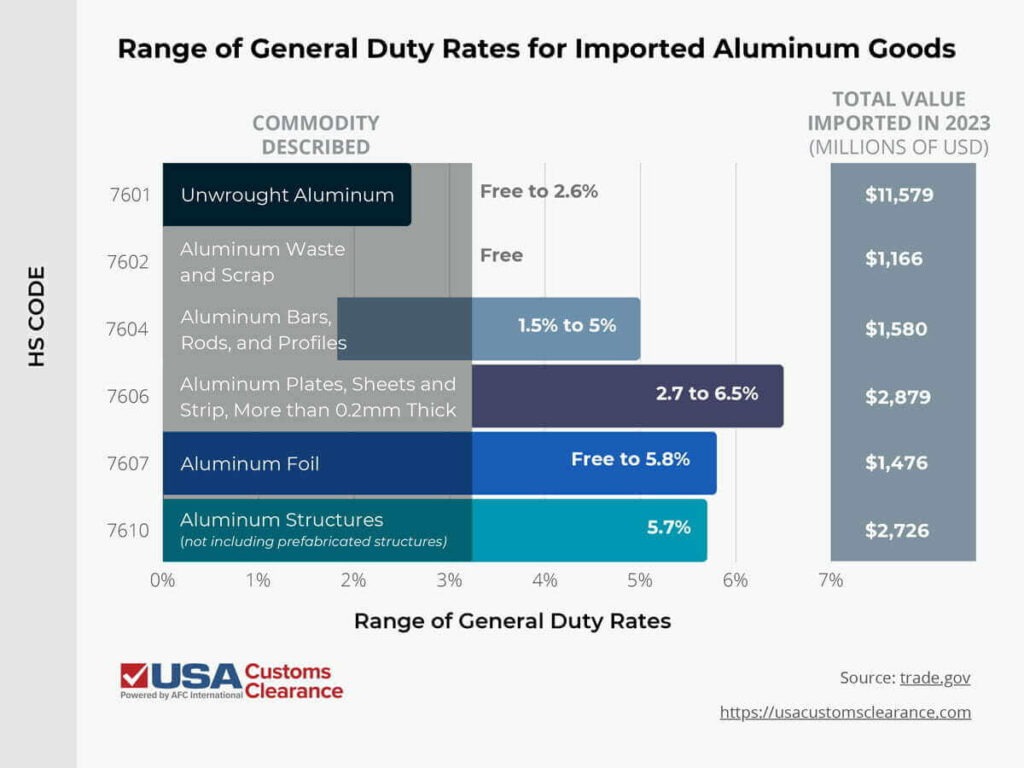
Illustration for a representative HS code, outside the scope of a separate anti-dumping order. Actual tariffs depend on the specific 8-digit HS code.
For finished aluminum extrusions covered by the Chinese anti-dumping/countervailing-duty orders issued in 2011 (case numbers A-570-967/C-570-968)-separate from the 2023-2024 case discussed below-the cumulative tariff burden on Chinese goods can exceed 78%, depending on the individual exporter’s dumping margin.
2023-2024 AD/CVD Case: Vietnam Was Cleared
In October 2023, the U.S. Aluminum Extruders Coalition filed an anti-dumping and countervailing-duty case targeting aluminum extrusions from 14 countries, including Vietnam and China. After more than a year of investigation, on October 30, 2024, the U.S. International Trade Commission (ITC) voted 2–1 that the U.S. domestic industry was not materially injured by imports from any of the 14 countries. As a result, no AD/CVD orders were issued, and all tariff deposits paid by importers during the investigation were refunded.
This distinction is important because it is separate from the anti-circumvention inquiry launched in July 2025-discussed in detail in the final compliance-risk section-and the two proceedings cover completely different products.
Multi-Market Comparison
Outside the U.S., Chinese aluminum extrusions also face anti-dumping duties in the EU (21.2-32.1%, under Regulation 2021/546), Canada (anti-dumping duties of up to 101% of export price for exporters without an individual margin), and Australia (combined duties vary by exporter, with some cases exceeding 27%). Vietnamese aluminum extrusions are currently not subject to comparable broad-based duties in these markets.
Chinese aluminum is subject to anti-dumping and/or countervailing measures in major markets, including the United States, Canada, European Union, United Kingdom, Australia and GCC countries.
This creates a clear opportunity for buyers to diversify their aluminum sourcing toward Vietnam, reducing exposure to China-related trade-remedy costs and supply-chain risks.
2. Vietnam’s FTA Network Makes It a Gateway to Multiple Markets, Not Just the U.S.
Vietnam joined the CPTPP (Comprehensive and Progressive Agreement for Trans-Pacific Partnership) on January 14, 2019. The agreement covers 11 economies including Japan, Canada, Mexico, Australia, New Zealand, Singapore, Malaysia, Peru, Chile, Brunei and Vietnam, eliminating import duties on 97-100% of tariff lines among members when rules of origin are satisfied.
Vietnam’s extensive FTA network provides preferential market access to major economies across North America, Europe and Asia-Pacific, including Canada, Japan, Australia, New Zealand, South Korea, Mexico, Chile, Peru, the UK, the EU, India and ASEAN markets, creating broader export opportunities for Vietnamese aluminum beyond the U.S. market.
CPTPP Is Only One Layer of Vietnam’s FTA Network
Beyond CPTPP, Vietnam also has multiple FTAs in force, each opening access to a distinct group of markets-an advantage that very few aluminum-producing countries in the region possess simultaneously, according Vietnam Chamber of Commerce and Industry, Vietnam have signed 17 FTAs, and 2 FTA under negotiation.
| Vietnam’s Main FTAs Relevant to Aluminum Exports | ||
| Agreement | Markets opened | Relevance to aluminum |
| EVFTA | European Union (27 countries) | Progressively reduces import duties on aluminum and aluminum products toward 0%, opening an alternative market for Chinese-AD-affected aluminum extrusions in the EU |
| CPTPP | 11 economies: Japan, Canada, Mexico, Australia, the UK (joined 2024), etc. | Eliminates 97–100% of tariff lines; provides the legal basis for the Mexico example above |
| ATIGA | ASEAN bloc | 0% intra-ASEAN tariffs, supporting regional supply chains for construction and automotive industries |
| AANZFTA | ASEAN – Australia – New Zealand | Parallel preferential access with CPTPP for the Australian market |
| RCEP | ASEAN + China, Japan, Korea, Australia, New Zealand | Harmonizes cumulative rules of origin across the Asia-Pacific region |
| UKVFTA | United Kingdom | Maintains tariff preferences equivalent to EVFTA after Brexit |
With 17 FTAs in force, Vietnam is one of the few aluminum-producing countries able to serve North America, Europe, Japan, Australia and ASEAN markets from the same manufacturing base- provided origin documentation is prepared correctly for each agreement.
3. Upstream Capacity Is Being Built at Structural Scale, Not Through Short-Term Arbitrage
Đắk Nông Aluminum Electrolysis Plant (Tran Hong Quan Metallurgy) – Vietnam’s first aluminum electrolysis plant, designed capacity 450,000 tonnes/year
Most notably: Đắk Nông Aluminum Electrolysis Plant produced the first commercial batch of aluminum ingots in the history of Vietnam’s aluminum industry on 26/7/2026, after 11 years of construction, with 99.71% purity using 500kA electrolysis technology. Phase 1 is operating at 150,000 tonnes/year; Phase 2 (300,000 tonnes/year) is expected to begin operation in Q4 2026, with all three phases reaching 450,000 tonnes/year in Q1 2027. The plant uses alumina feedstock from the Nhân Cơ complex in Đắk Nông and Tân Rai in Lâm Đồng, operated by Vietnam National Coal and Mineral Industries Group (TKV), and is expected to reduce aluminum import expenditure by approximately USD 1.5 billion per year.
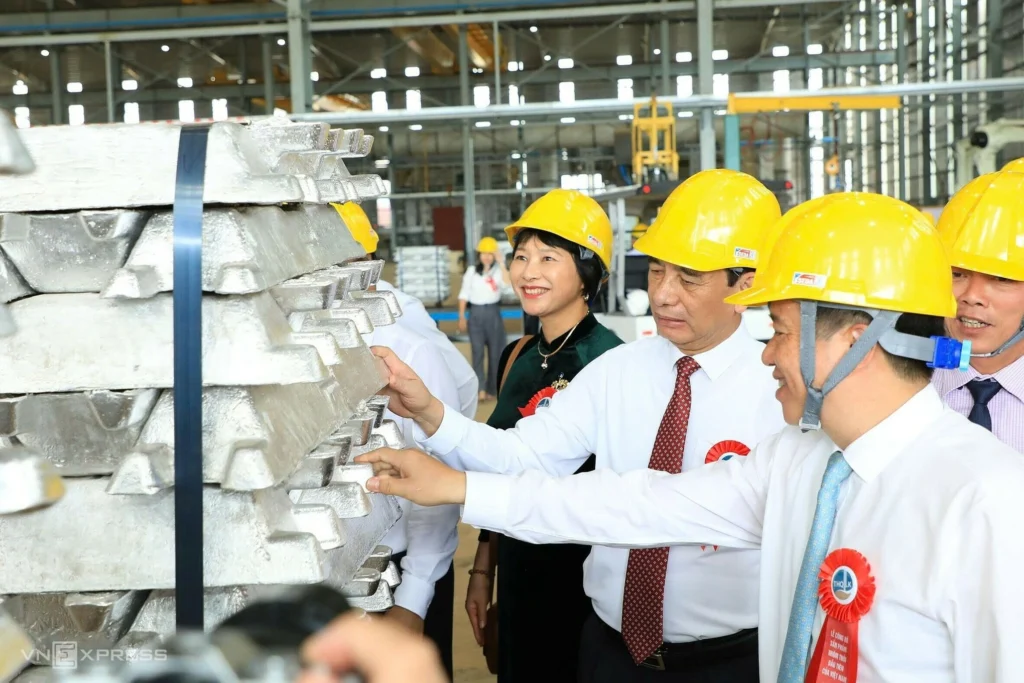
Investment in Three Upstream Aluminum Projects in Vietnam’s Central Highlands
For buyers, the significance is clear: these are capital-intensive infrastructure investments with payback periods measured in decades-very different from processing or assembly models that can relocate within months when tariff policy changes. A supply chain built on actual local mining and metallurgy does not disappear simply because tariffs are adjusted.
4. Structurally Lower Conversion Costs-Independent of Tariff Policy
Die tooling costs in Vietnam are 50-70% lower than domestic U.S. production; per-meter processing prices are 35-55% lower. This advantage comes from technical labor and manufacturing-site costs-it does not depend on whether U.S. tariffs rise or fall in the future, making it considerably more durable than a tariff-only differential.
LME Aluminum Cash Price Trend (USD/tonne), 2024–2026
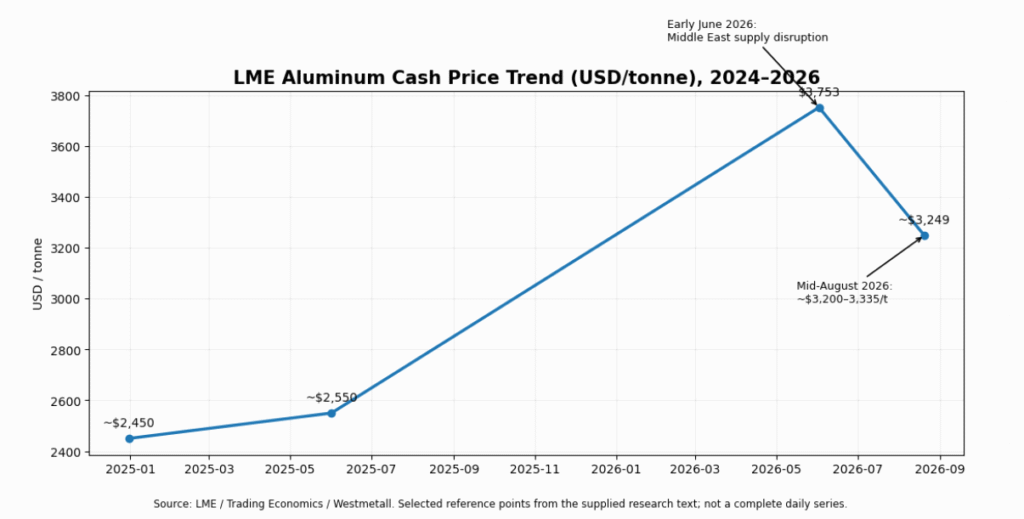
Source: Trading Economics, LME.com, MetalCharts.org (19-20/8/2026)
LME aluminum prices have been highly volatile in 2026: from below USD 2,500/tonne at the end of 2024, they rose as Section 232 increased the steel-and-aluminum tariff to 50% in June 2025, then surged to nearly USD 3,750/tonne in early June 2026 amid Middle East supply disruptions, before correcting to the range 3.200-3.335 USD/tonne in mid-August 2026. Vietnam’s domestic 6063 aluminum billet prices, used as extrusion feedstock, moved around the equivalent of VND 80-92 million/tonne in the first half of 2026, tracking LME levels plus freight and FX differences-with no unusual gap versus global prices.
Reverse Protection: Vietnam Also Applies Anti-Dumping Measures to Chinese Aluminum
Under Decision 1149/2024 of Vietnam’s Ministry of Industry and Trade, aluminum extrusions imported from China (HS 7604.10) are subject to anti-dumping duties ranging from 2.85% to 35.58%, depending on the exporter, effective December 1, 2024. This shows that Vietnam’s downstream aluminum industry is protected against low-priced Chinese billet and unfair competition with domestic producers-reinforcing the “real production” character of domestic supply.
Vietnam Aluminum Market Size, 2025-2031
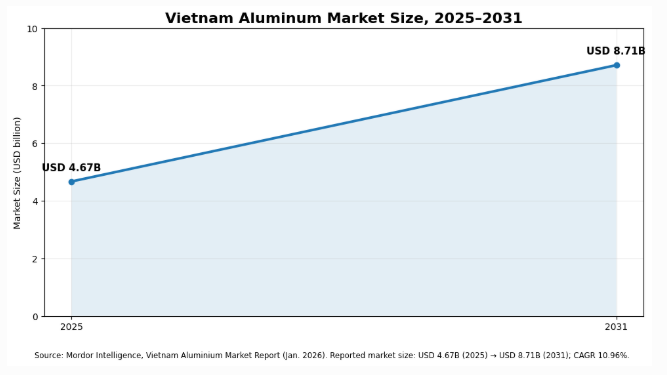
Source: Mordor Intelligence, Vietnam Aluminium Market Report (cập nhật 1/2026)
Vietnam’s aluminum market is projected to grow from USD 4.67 billion in 2025 to USD 8.71 billion in 2031, representing a 10.96% CAGR-one of Asia’s faster-growing value chains according to Mordor Intelligence. Aluminum extrusions accounted for 39.42% of the market in 2025, driven by demand for window frames, curtain walls and construction infrastructure valued at USD 95.8 billion by 2027.
5. Vietnam Has Demonstrated Its Ability to Absorb China-Scale Volumes
The biggest concern for buyers shifting supply chains is whether the alternative country has enough production capacity and quality-management capability to absorb large order volumes. For aluminum, the answer can be informed by two industries that have already completed this transition.
Factories certified to IATF 16949 (automotive quality-management standard)-second in ASEAN after Thailand
The same trajectory is emerging in aluminum: Vietnam’s exports of aluminum and aluminum products to the U.S. span multiple HS categories-bars and profiles (HS 7604), tubes and pipes (HS 7608), and plates and foil (HS 7606)-reflecting a diversified factory ecosystem rather than dependence on a few small processors. The presence of 858 IATF 16949-certified factories is also an indirect signal of quality-management capabilities transferable to industrial aluminum manufacturing, as many aluminum factories serve both automotive and construction industries.
In other words, Vietnam’s aluminum industry is not pioneering this shift alone. It is following a path already taken by textiles and furniture during 2018-2024-organized order migration supported by infrastructure investment, rather than a temporary processing wave.
Minh Dung Aluminum – A Transparent, Origin-Compliant Manufacturing Partner
With 6060 / 6061/6063 aluminum billet casting and extrusion operations in Vietnam, Minh Dung Aluminum builds production processes and traceability records designed to meet C/O requirements under CPTPP and EVFTA and CBP inspection standards-helping international partners source from Vietnam with confidence in compliance, not just price.
Low carbon – CBAM 6061 /6060 / 6063 Aluminum Billet CPTPP & EVFTA Certificates of OriginTransparent Traceability – Made in Vietnam