As Europe accelerates the transition toward energy-efficient buildings, renewable energy and more diversified supply chains, Vietnam aluminum profiles are becoming an increasingly interesting sourcing option for European buyers.
Vietnam has developed a strong manufacturing base for aluminum billets, extrusion profiles and downstream processing. At the same time, the EU–Vietnam Free Trade Agreement (EVFTA), growing demand for building renovation and the EU’s new carbon regulations are creating new opportunities for Vietnamese aluminum profile exporters.
For European importers, sourcing aluminum profiles from Vietnam is therefore not only about price. It is also about trade preferences, supply-chain diversification, customization, recycled materials and sustainability.
1. EVFTA Creates a Favorable Trade Framework
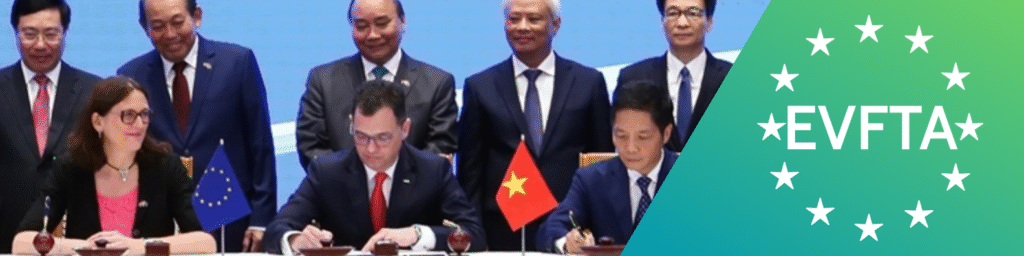
One of the most important advantages of exporting aluminum profiles from Vietnam to Europe is the EU-Vietnam Free Trade Agreement (EVFTA), which entered into force on 1 August 2020.
The agreement provides a framework for eliminating or reducing tariffs on a wide range of products traded between Vietnam and the European Union. For relevant aluminum profile products under HS heading 7604, preferential tariff treatment may apply when the products satisfy the applicable rules of origin and proof-of-origin requirements.
This can improve the cost structure for European buyers compared with sourcing from countries subject to the EU’s standard tariff.
However, preferential treatment should not be interpreted simply as “shipping from Vietnam means 0% duty.” Importers should verify the exact HS code, applicable tariff schedule and origin documentation for each product.
For professional buyers, this makes Vietnam particularly interesting as part of a diversified European sourcing strategy.
In addition, Vietnam aluminum profile is not affected by the anti-dumping duty like China range between 21.2% and 32.1%.
2. Vietnam Provides an Alternative Asian Supply Base
European companies are increasingly paying attention to supply-chain resilience.
Vietnam has become an important manufacturing hub in Asia, with established industries in electronics, machinery, furniture, construction materials and metal processing. This industrial ecosystem supports the development of increasingly sophisticated aluminum extrusion capabilities.
According to World Bank WITS/UN Comtrade data, the EU imported approximately US$11.57 million of hollow alloyed aluminum profiles from Vietnam under HS 760421 in 2024, demonstrating that Vietnamese aluminum profiles already have a presence in the European market. [1]
For European buyers, Vietnam can therefore serve as an additional sourcing location rather than relying on a single production market.
3. European Building Renovation Supports Aluminum Demand
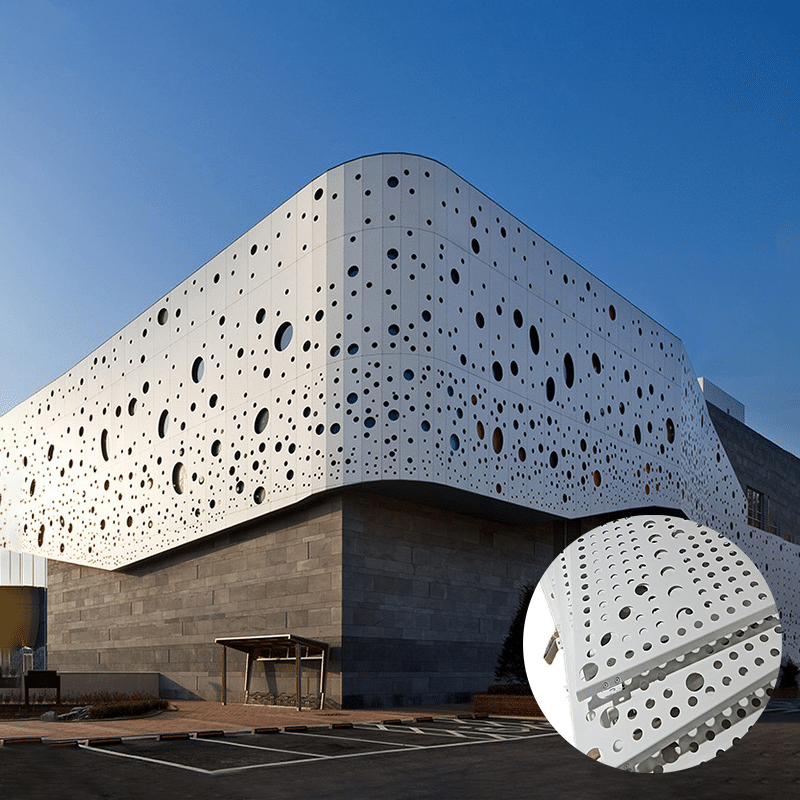
Construction is one of the largest application areas for aluminum extrusion. Aluminum profiles are widely used for windows, doors, façades, curtain walls, partitions and other building components.
The European Commission reports that around 85% of EU buildings were constructed before 2000 and approximately 75% have poor energy performance. The EU is therefore placing greater emphasis on building renovation and energy efficiency. [2]
The revised Energy Performance of Buildings Directive (EPBD) is designed to accelerate improvements in the energy performance of Europe’s building stock.
This creates opportunities for aluminum profile manufacturers supplying components for modern building envelopes, windows, doors and façade systems.
For Vietnamese exporters, the opportunity is not simply selling more aluminum. It is supplying aluminum profiles that meet increasingly demanding requirements for:
- Dimensional accuracy
- Mechanical properties
- Surface quality
- Durability
- Thermal-performance systems
- Customized architectural designs
4. Solar Energy Is Creating Another Market for Aluminum Profiles
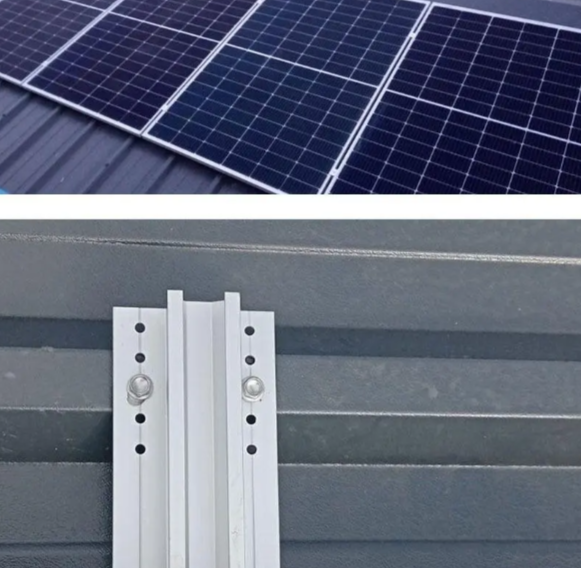
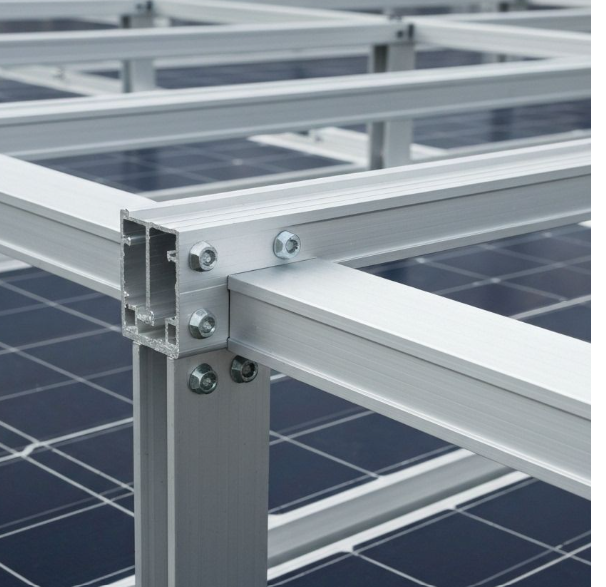
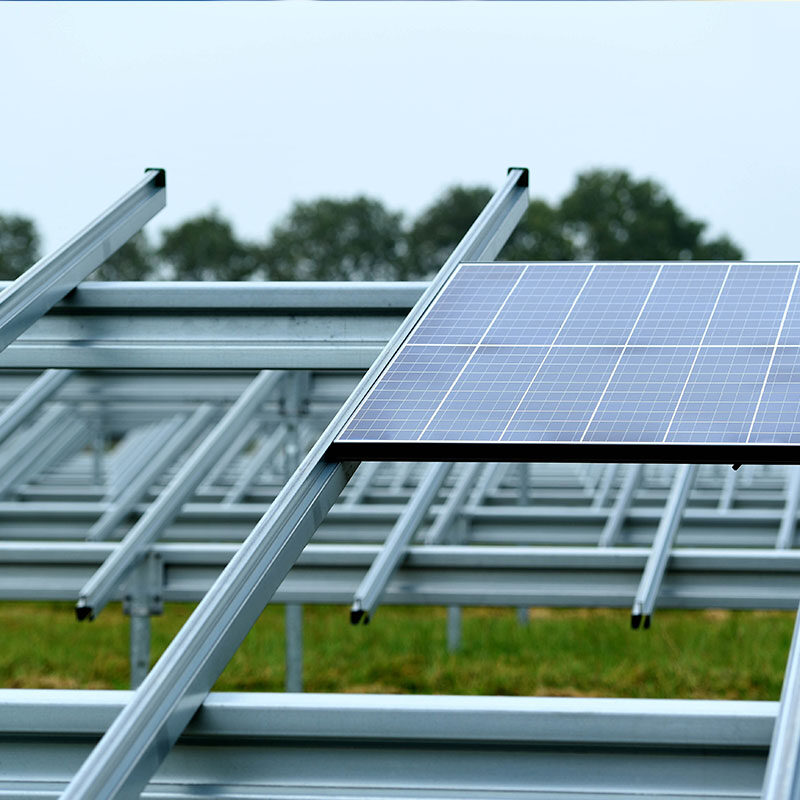
The European transition toward renewable energy is another important demand driver. The revised EPBD introduces measures to increase the deployment of solar energy on buildings. [3] Solar mounting systems rely heavily on lightweight and durable aluminum components because extrusion allows manufacturers to produce complex structural geometries efficiently.
Typical products include:
This creates an opportunity for Vietnamese aluminum extrusion manufacturers to serve both the construction sector and renewable-energy sector in Europe.
5. Recycling Aluminum Scrap Can Reduce the Carbon Footprint
Sustainability is becoming an increasingly important factor in the European aluminum supply chain. Unlike many materials, aluminum can be recycled repeatedly without losing its fundamental material properties. Aluminum scrap from manufacturing processes, extrusion off-cuts and end-of-life products can be collected, sorted, remelted and converted into new aluminum billets for further extrusion.
This creates a circular material cycle: One of the major environmental advantages of recycling aluminum is its significantly lower energy requirement compared with producing primary aluminum from bauxite.
According to the International Aluminium Institute (IAI), recycling aluminum requires approximately 5% of the energy needed to produce primary aluminum. [4]
This substantial difference means that increasing the use of suitable recycled aluminum can contribute to reducing the energy intensity and associated greenhouse-gas emissions of aluminum production.
For European buyers, this is becoming particularly relevant as the EU strengthens its climate policies and introduces the Carbon Border Adjustment Mechanism (CBAM).
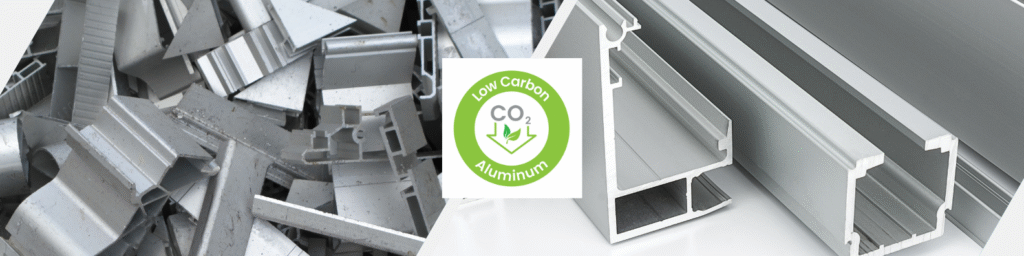
From Aluminum Scrap to Low-Carbon Billet and Profile
A manufacturer with an established recycling and remelting operation can create additional value from aluminum scrap. The resulting billet can then become the raw material for architectural, industrial or solar aluminum profiles.
This approach supports the principles of the circular economy by keeping aluminum within the material cycle and reducing the need for newly produced primary metal.
However, recycled content should not automatically be treated as equivalent to a specific carbon footprint. The actual emissions of an aluminum product depend on factors such as the origin and type of scrap, electricity mix, melting process, alloying, transportation and other production stages.
For this reason, European buyers increasingly need traceable information about material origin and production emissions, rather than relying solely on general claims such as “green aluminum” or “eco-friendly aluminum.”
6. CBAM Makes Carbon Data Increasingly Important
The EU’s Carbon Border Adjustment Mechanism (CBAM) entered its definitive regime on 1 January 2026 and covers aluminum among other carbon-intensive sectors. [5]
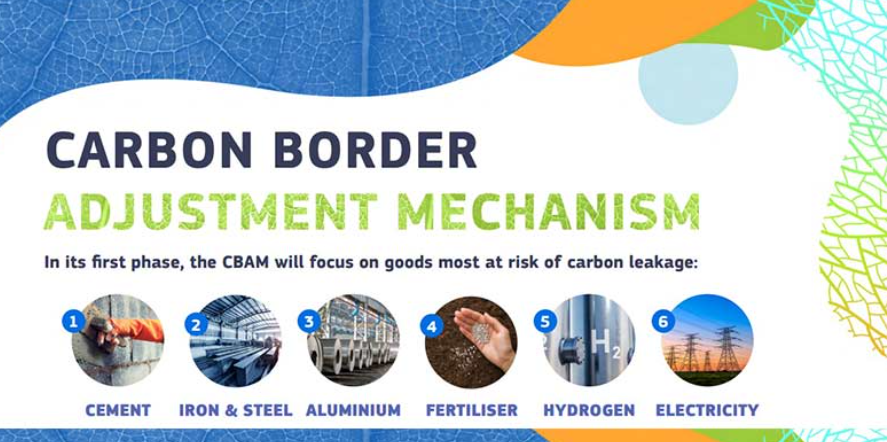
For European importers, embedded emissions associated with imported aluminum are increasingly relevant. This changes the traditional definition of competitiveness.
European buyers may increasingly evaluate:
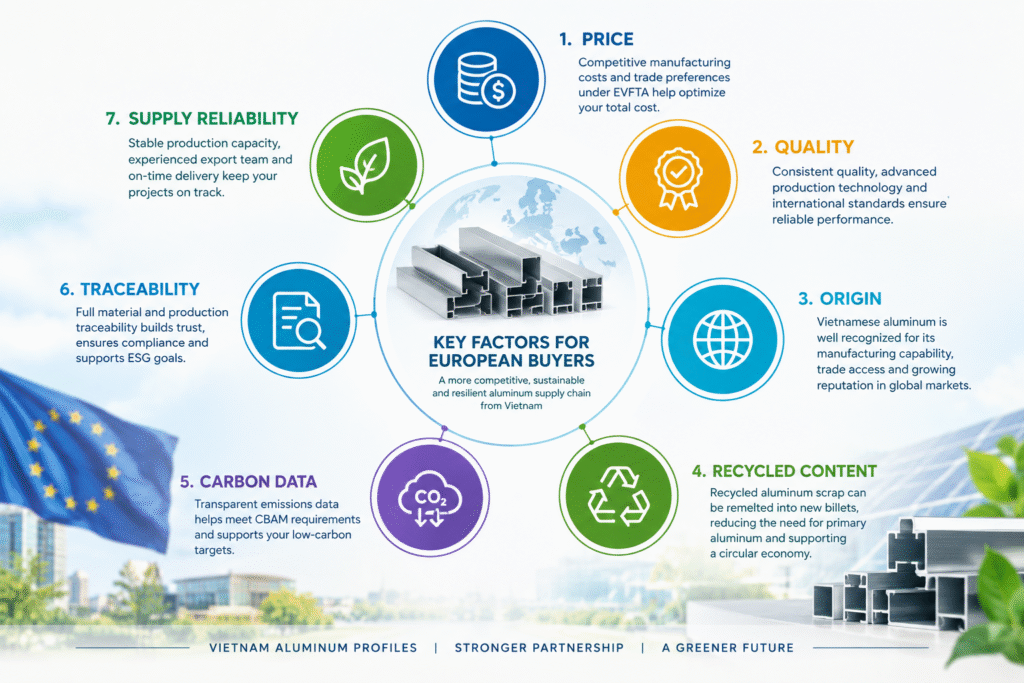
For Vietnamese aluminum manufacturers, therefore, recycling can become more than an environmental initiative. It can form part of a broader strategy for developing lower-carbon aluminum products and more transparent supply chains.
The European Commission has also published specific CBAM guidance for the aluminum sector covering emissions calculations, monitoring and verification. [6]
For exporters, maintaining accurate information on raw materials, recycled content, electricity consumption, production processes and emissions can help European customers better understand the environmental characteristics of their imported aluminum.
7. Why Custom Aluminum Extrusion Profile Matters
European buyers often require more than standard aluminum bars.
Many manufacturers need profiles produced according to their own technical drawings, including specific:
- Alloy
- Temper
- Cross-sectional dimensions
- Wall thickness
- Length
- Surface finish
- Tolerances
- Machining requirements
The ability to provide customized extrusion allows Vietnamese suppliers to participate in higher-value applications rather than competing purely on commodity pricing.
Common alloys for extrusion include 6063, 6061 and 6005/6005A, depending on the required mechanical and application characteristics.
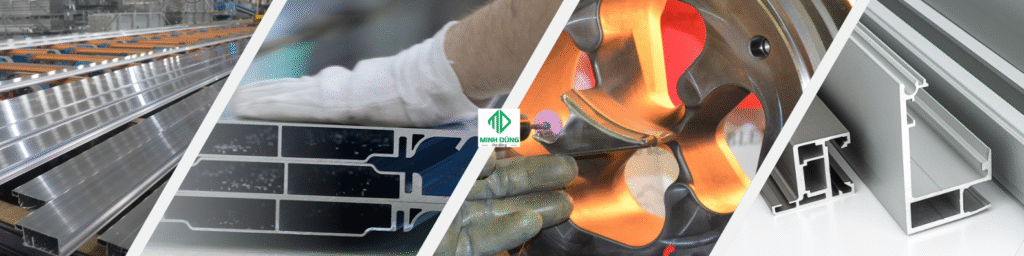
Why Choose Minh Dung Aluminum as Your Vietnam Aluminum Profile Supplier?
Minh Dung Aluminum is a Vietnam-based aluminum profile manufacturer supplying customs extruded profiles for international customers.
An important part of Minh Dung’s aluminum supply chain is the ability to utilize recycled aluminum materials and aluminum scrap as inputs for remelting and billet production.
Instead of treating suitable aluminum scrap as waste, the material can be processed, remelted and converted into aluminum billets, which can subsequently be used for extrusion.
Such an approach can help reduce dependence on primary aluminum and support lower-carbon aluminum production, subject to the actual scrap composition, energy source and production process.
Minh Dung offers aluminum profile in commonly used 6xxx-series alloys, including 6063, 6061 and 6005, with customized profiles manufactured according to customer drawings and technical specifications. [7]
Our company can support applications including:
- Construction and architecture
- Windows and doors
- Curtain walls
- Solar mounting systems
- Industrial machinery
- Furniture
- HVAC
- Customized industrial components
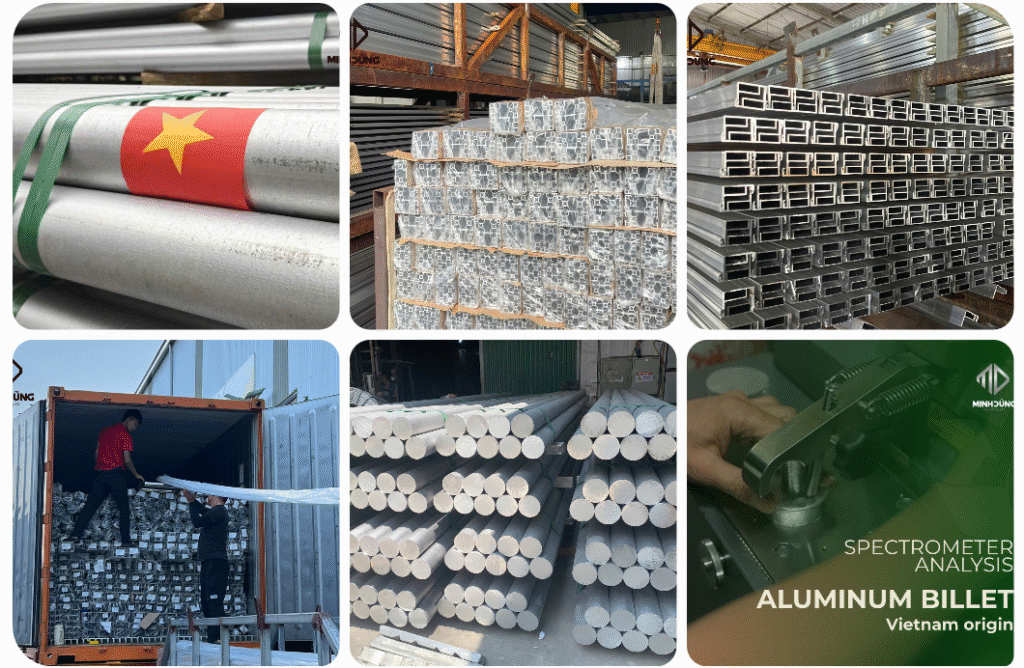
Minh Dung Aluminum also provides various finishing and processing options, including mill finish, anodizing, powder coating, electrophoresis, wood grain, cutting and CNC machining, depending on project requirements. [7]
The company states that its management system is supported by ISO 9001, ISO 14001 and ISO 45001 certifications, while its published company information indicates approximately 40,000 MT of annual billet and extrusion capacity. [8]
For European buyers, this combination of recycled aluminum sourcing, billet production, extrusion manufacturing, customization and export capability provides a potential foundation for developing a more diversified and circular aluminum supply chain between Vietnam and Europe.
Conclusion
The European aluminum market is changing rapidly. EVFTA provides a preferential trade framework between Vietnam and the EU, building renovation supports demand for architectural profiles, solar deployment creates new extrusion applications, and CBAM is making carbon transparency increasingly important.
At the same time, recycling aluminum scrap into new billets/profile can significantly reduce energy requirements compared with primary aluminum production, supporting the transition toward a more circular and potentially lower-carbon aluminum supply chain.
For European importers, Vietnam therefore offers an increasingly relevant combination of manufacturing capability, trade access, customization and circular-material opportunities.
For buyers looking for a Vietnam aluminum profile manufacturer, Minh Dung Aluminum can support projects involving aluminum billets, standard and customized extrusion profiles, surface treatment and downstream processing.
Send us your technical drawing, alloy, temper, surface treatment and estimated monthly quantity to discuss the suitable aluminum extrusion solution for your European market.
References
[2] European Commission, Energy Performance of Buildings Directive (EPBD).
[3] European Union, Directive (EU) 2024/1275 on the Energy Performance of Buildings.
[4] International Aluminium Institute, Aluminium Recycling.
[6] European Commission, CBAM Guidance for the Aluminium Sector, 2026.
[7] Minh Dung Aluminum, Aluminum Extrusion Products and Capabilities.
[8] Minh Dung Aluminum, Company Profile and Manufacturing Information.