Aluminum Extrusion Standards You Should Know (TCVN – JIS – ASTM)
In manufacturing and construction, aluminum extrusion standards are not just technical specifications. In practice, they are the basis for evaluating material quality, meeting design requirements, and most importantly, complying with legal and export requirements.
Whether you are a contractor, a purchasing officer, or an aluminum exporter, understanding the differences between TCVN (Vietnam), JIS (Japan), and ASTM (USA) standards helps you select the right material, reduce technical risks, and avoid commercial disputes.
This article focuses on the three most commonly used standards for extruded aluminum profiles today.
1. Why are aluminum extrusion standards important?
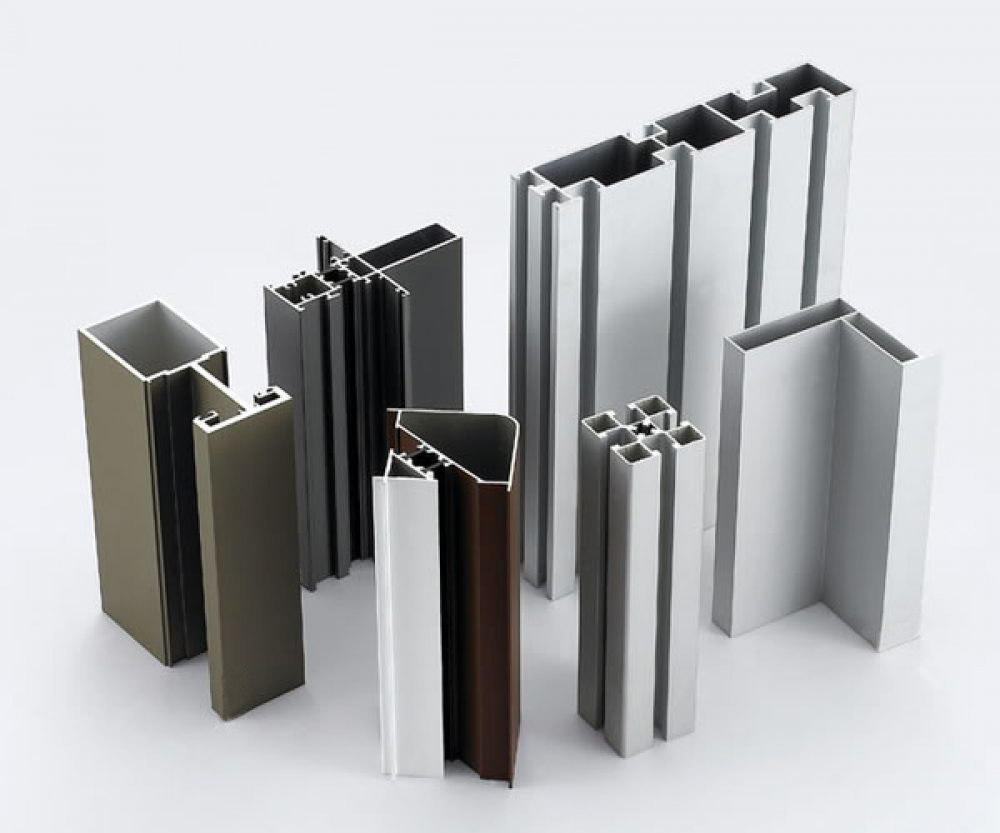
Aluminum profiles are widely used in windows, curtain walls, structural frames, machinery parts, and industrial components. Without proper standards, products may suffer from problems such as warping, dimensional inaccuracy, or insufficient mechanical strength.
Technical standards ensure the mechanical strength of aluminum profiles, control chemical composition (especially silicon and magnesium in the 6xxx alloy series), and define dimensional tolerances to guarantee proper assembly. More importantly, for FDI projects and export markets, compliance with standards is a mandatory legal requirement for material approval.
2. Vietnam Standard – TCVN 12513:2018
In Vietnam, the current national standard for wrought aluminum and aluminum alloys is TCVN 12513:2018, which is fully equivalent to ISO 6362.
TCVN 12513 covers supply conditions, inspection methods, and mechanical properties such as tensile strength, yield strength, and elongation. It also strictly controls geometric tolerances, including straightness, twist, and flatness, which are critical for aluminum windows and curtain wall installation.
In practice, aluminum profiles used in domestic construction projects are required to comply with TCVN 12513 or related regulations such as QCVN 16:2019/BXD to be accepted during material inspection.
3. Japanese Standard – JIS H4100
For the Japanese market and Japan-funded projects, JIS H 4100 is almost mandatory for extruded aluminum profiles. A key feature of JIS is its very strict control over chemical composition and surface quality.
Common JIS alloys such as A6063S-T5 and A6061S-T6 require stable and uniform alloy composition. In addition to mechanical properties, JIS standards are closely linked to surface treatment standards like JIS H 8601 (anodizing) and JIS H 8602 (organic coating). These standards require aluminum surfaces to be smooth, clean, and free from scratches or extrusion marks.
As a result, JIS-compliant aluminum is widely used in high-end aluminum windows, electronic components, and precision machinery parts, where appearance and consistency are critical.
4. American Standard – ASTM B221
For the U.S. market and many international projects, ASTM B221 is the most widely used standard for extruded aluminum and aluminum alloys. This standard places strong emphasis on mechanical properties and testing methods, especially tensile testing.
ASTM uses a clear alloy designation system such as 6063, 6061, and 6005, combined with temper conditions like T5 or T6. This makes design review, quality control, and inspection more transparent and easier to manage.
In reality, many construction projects in Vietnam designed by foreign consultants specify ASTM B221 instead of TCVN, in order to align with global engineering standards.
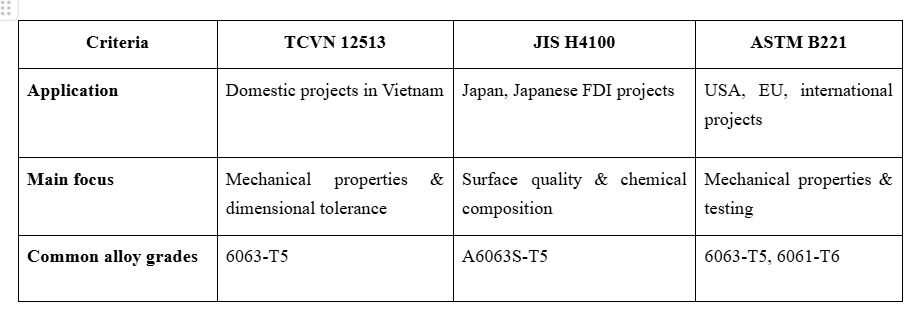
5. Quick Comparison: TCVN – JIS – ASTM
6. Conclusion
Each aluminum extrusion standard serves a different purpose and market. Choosing the right standard not only ensures technical quality but also helps reduce risks during inspection, acceptance, and commercial transactions.
For domestic projects in Vietnam, TCVN 12513 is a suitable choice and ensures full legal compliance. For orders that require high surface quality or are exported to Japan, JIS H 4100 should be prioritized. Meanwhile, ASTM B221 is widely used for international projects, especially for the U.S. and European markets.
If you need further support on technical requirements or pricing, please feel free to contact us.
Mia Ha
Export–Import Sales Department
Website: https://nhomminhdung.vn/
Email: kinhdoanh@nhomminhdung.vn
Hotline/WhatsApp: +84 332 008948